Whole wheat behaves nothing like white flour. The bran absorbs more water, cuts gluten strands as it hydrates, and ferments roughly 30% faster because of the enzymes and wild yeast living on the wheat kernel. If you're getting dense, gummy loaves with weak oven spring, the fix usually isn't more skill — it's adjusting hydration, timing, and your expectations about protein.
This article covers what actually matters: how much water to add, when to shape, and why a 14% protein whole wheat flour can produce a worse loaf than an 11% one.
Why whole wheat is harder than white
When you mill the whole wheat berry, you get three things: endosperm (the starchy interior that becomes white flour), germ (the embryo, full of oils and enzymes), and bran (the fibrous outer layers). The bran is the problem child.
Bran particles are sharp. As you mix and stretch the dough, they slice through gluten sheets like little razors. This is why whole wheat doughs feel strong at first, then go slack, then never quite recover the elasticity you'd expect from the protein content on the label.
The germ adds enzyme activity — particularly amylase and protease — that speeds fermentation and weakens gluten over time. Whole wheat ferments faster and the gluten gets weaker the longer it sits. Both clocks are ticking against you, which is why timing matters more here than in any other bread.
Hydration: the numbers that actually work
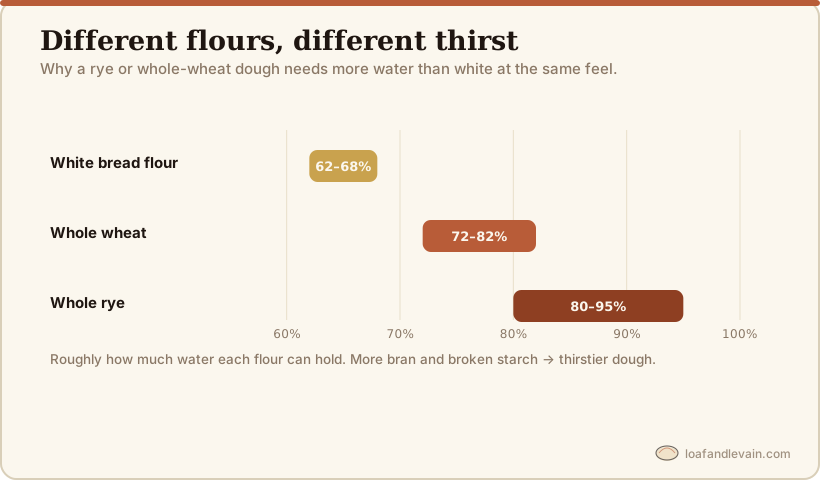
A standard white sourdough at 75% hydration will absorb similar water in a whole wheat blend, but the dough will feel very different over time. Bran keeps drinking water for hours after mixing. A dough that feels stiff at mixing can feel slack at shaping. If you want the underlying logic of baker's percentages, the hydration explainer lays it out — this section is just the whole-wheat-specific numbers.
Here are working hydration ranges by whole wheat percentage:
| Whole wheat % | Target hydration | Notes |
|---|---|---|
| 20–30% | 75–78% | Behaves close to white; standard timing works |
| 40–50% | 78–82% | Sweet spot for most home bakers |
| 60–75% | 82–87% | Reduce bulk time by 15–20% |
| 100% | 85–95% | Hardest to handle; expect a tighter crumb |
These are starting points, not gospel. Stone-ground flour absorbs more than commercial roller-milled flour. Freshly milled flour absorbs less the first few days (the bran hasn't fully hydrated through storage) and more after a week of rest. If you mill your own, give the flour 24–48 hours before baking with it.
Autolyse, or fermentolyse?
For whole wheat, skip the long autolyse. A 30–60 minute autolyse with white flour builds gluten beautifully. With whole wheat, the bran enzymes start breaking down protein during a long rest, leaving you with a slacker, stickier dough. The full trade-off is in autolyse vs fermentolyse; the short version for whole wheat:
- Short autolyse (20–30 minutes) with just flour and water, then add salt and levain.
- Fermentolyse — mix everything (flour, water, levain, salt) at once and start bulk immediately.
The fermentolyse approach gives you more control because fermentation acidifies the dough, which actually strengthens gluten against the bran's enzymatic assault.
Timing: shorter bulk, longer cold proof
The single biggest mistake with whole wheat is treating the bulk fermentation timeline like white sourdough. A bulk that takes about 5 hours with white flour at 24°C (75°F) and 20% starter might be done in 3.5 hours with a 50% whole wheat dough at the same temperature. The temperature math behind those numbers — the Q10 ≈ 2.2 curve — is covered in bulk fermentation by temperature; whole wheat just runs that same curve faster.
Watch the dough, not the clock. You're looking for:
- 20–40% rise (not the 50–75% you'd push white dough to)
- Visible bubbles on the surface and sides of a clear container
- A jiggly, domed top when you tap the bulk container
If you wait for the same volume increase you get with white flour, you're already past peak. Whole wheat doesn't recover from over-fermentation — the gluten is too compromised by the bran. Underproofing slightly is far more forgiving than overproofing.
The cold retard is your friend
A 12–16 hour cold retard at 3–4°C (38–40°F) does more for whole wheat sourdough than for any other bread. Cold slows the enzymes, lets flavors develop, and firms the dough up enough that you can actually score it without it deflating. If you're weighing it against a same-day finish, cold retard vs same-day compares the two schedules directly.
If you have any doubt about bulk timing, err on the early side and let the cold proof finish the job. A loaf shaped slightly underproofed and retarded 14 hours will outperform a perfectly bulk-proofed loaf retarded 6 hours nine times out of ten.
Protein: the label lies (sort of)
Whole wheat flour labeled at 14% protein doesn't behave like white bread flour at 14% protein. Two reasons:
- Not all that protein is gluten-forming. The bran and germ contain non-gluten proteins that show up on a Kjeldahl nitrogen test but contribute nothing to dough structure.
- Variety matters more than percentage. Hard red winter wheat at 12.5% protein often produces stronger dough than hard red spring at 14%, because of the gluten quality, not quantity.
For sourdough, look for:
- Hard red winter or hard red spring wheat for structure
- Hard white wheat for milder flavor with similar strength
- "Bread flour" or "high-protein" whole wheat rather than all-purpose whole wheat
Avoid soft white wheat (sometimes called pastry wheat) for sourdough — it has weak, extensible gluten suited to muffins and cookies, not bread.
Fresh-milled vs. commercial
Fresh-milled whole wheat has more enzyme activity, more flavor, and weaker gluten than commercial whole wheat that's been sitting for months. The reason is simple: the germ is full of oils, and once the kernel is broken open those oils slowly react with air. That reaction dulls the bright, grassy flavor of fresh flour, but it also calms down some of the enzyme activity, so older commercial flour is a little more predictable and easier to handle — flatter in taste, steadier on the bench.
If you mill your own:
- Sift out 10–15% of the coarsest bran for better volume
- Use slightly less water at first; the flour absorbs more over time
- Reduce bulk fermentation by another 10–15%
A working formula for 50% whole wheat
This is the formula I recommend to bakers transitioning from white sourdough. Use the calculator to scale it to your loaf size and to set your water temperature from your kitchen and flour temps.
- 250g whole wheat flour (50%)
- 250g bread flour (50%)
- 400g water (80%)
- 100g levain at 100% hydration (20%)
- 10g salt (2%)
Method:
- Mix everything except salt. Rest 30 minutes.
- Add salt with 15g additional water. Mix until incorporated.
- Bulk ferment at 24–26°C (75–79°F) for 3.5–4.5 hours.
- Stretch and fold 3 times in the first 90 minutes, then leave alone. (If your folds feel weak, the stretch and fold guide has the mechanics.)
- Shape when dough is jiggly and risen 30%.
- Cold retard 12–16 hours at 3°C (38°F).
- Bake at 245–260°C (475–500°F) covered for 20 minutes, then 230°C (450°F) uncovered for 22–25 minutes.
Once this works consistently, push the whole wheat to 70%, then 100%. Don't jump.
Common problems and what they mean
Gummy crumb
Almost always underbaked or underproofed. Any sourdough should reach an internal temperature of 96–99°C (205–210°F); whole wheat wants the top of that range, 97–99°C (207–210°F), because the extra bran holds moisture and needs more heat to fully set. If yours is gummy even when fully baked, work through why sourdough turns out gummy — the causes there apply doubly to whole wheat.
Dense loaf with no oven spring
Usually overproofed bulk, occasionally weak starter. If your starter doubles in 4+ hours at 26°C (79°F), it's not strong enough for whole wheat. Feed twice daily for 3–4 days before baking. For the broader checklist, see fixing dense sourdough.
Sticky, unworkable dough at shaping
Either too much water for your specific flour, too long an autolyse, or overproofed bulk. Try the same formula at 5% less hydration next time and use a 20-minute fermentolyse instead.
Pale crust
Whole wheat browns differently than white. The sugars from amylase activity get consumed during the longer effective fermentation. Push your bake temperature higher (260°C / 500°F start) and consider a longer cold retard, which preserves more residual sugars for crust color.
Common questions
Can I use whole wheat starter for white bread, and vice versa?
Yes. The flour you feed your starter affects flavor but not function. A whole wheat starter will ferment slightly faster and add a nuttier taste to any dough. Many bakers keep a single whole wheat starter because it's more active and resilient than a white one.
Should I use a 100% whole wheat starter for whole wheat bread?
It helps but isn't essential. A more active starter handles the faster fermentation of whole wheat dough better. If your starter is sluggish, switch to whole wheat or rye feedings for a week before baking a whole wheat loaf — the starter feeding ratio guide covers how to keep it peaking on schedule.
Why does my 100% whole wheat loaf have a tight crumb no matter what?
That's largely the nature of the flour. Bran physically prevents the large, open air pockets you get in white sourdough. You can improve it with higher hydration (88%+) and gentle handling, but a pillowy ear-and-honeycomb crumb isn't realistic at 100% whole wheat. Aim for even, medium-fine crumb instead.
How much can I push hydration before the dough becomes unworkable?
With 50% whole wheat, you can go to 85% comfortably. With 100%, 90% is the practical ceiling for most home bakers. Beyond that you need a stiff levain, lamination instead of stretch-and-folds, and a banneton dusted heavily with rice flour. Diminishing returns set in fast.
Is sifted whole wheat (high-extraction) easier to work with?
Much easier. Sifting out 10–20% of the coarse bran gives you most of the flavor and nutrition of whole wheat with significantly better gluten development. T85 or high-extraction flours (around 85% extraction rate) are the sweet spot for bakers who want whole wheat character without the handling difficulty.
Do I need vital wheat gluten?
No. It's a workaround that produces a slightly rubbery crumb. Better starter, better timing, and a hard red wheat variety will do more than added gluten ever does.
The flour decides; you adjust
Whole wheat is the one flour where the same recipe genuinely won't repeat from bag to bag. A stone-ground hard red from one mill drinks 5% more water and ferments faster than a roller-milled bag from the supermarket, and a sack you milled this morning behaves differently from the same berries milled three weeks ago. I keep a strip of tape on each flour bin with the date it was opened, because the flour I bought in March is not the flour I'm baking with in May — and pretending otherwise is how good bakers get a mystery dense loaf.
So don't chase a single perfect formula. Chase three readings every bake: the hydration that gave you a workable dough, the rise percentage you shaped at, and the internal temperature you pulled at (aim for 97–99°C / 207–210°F, never below 96°C / 205°F). Write those three down. Within four or five loaves you'll stop reading the dough like a stranger and start steering it — adding water when the bran is thirsty, shaping early when the kitchen is warm, pulling at the right colour instead of the right minute. The flour sets the terms; your job is just to keep noticing what it's telling you.