Your kitchen hits 28°C (82°F) and suddenly the bulk ferment you nailed all winter turns into a slack, over-proofed puddle by the time you go to shape it. This is the summer sourdough problem, and almost every home baker runs into it once the seasons shift.
The fix isn't complicated, but it means letting go of the rigid recipe times you've been following. In summer, the dough sets the pace, not the clock.
Why summer changes everything
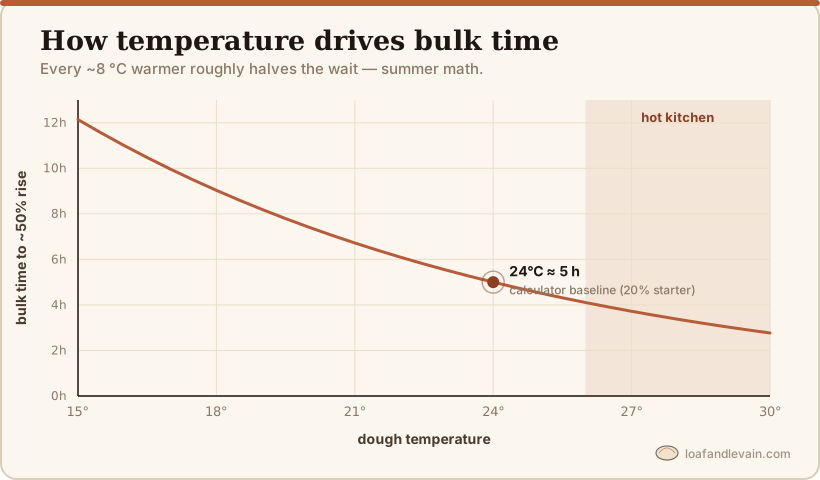
Fermentation speed rises sharply with temperature. A practical rule that matches the calculator on this page and the rest of this site: rate roughly multiplies by 2.2x for every 8°C (14°F) increase in dough temperature, within the range we care about. So a dough at 26°C (79°F) ferments noticeably faster than one at 22°C (72°F), and at 28°C (82°F) it's flying. Lactic acid bacteria shift too — warmer doughs tend to push more lactic acid the longer fermentation drags on, which changes flavor as well as timing.
Two things go wrong in summer:
- Bulk fermentation overshoots. You follow a 5-hour bulk that worked in March, and by hour 3 the dough is already 90% risen, gassy, and sliding off the bench scraper.
- The dough heats up during bulk. Mixing generates friction. A warm kitchen heats the dough further. By the end of bulk, dough that started at 24°C (75°F) can be 28°C (82°F) or more — and the last hour ferments at the fastest rate of all.
Both problems compound. The result is over-proofed dough that turns into a flat, sour, gummy loaf. (If the flat-and-gummy part is your recurring failure, the mechanism is worth understanding in /sourdough/why-sourdough-gummy/.)
The single most important number: dough temperature
If you don't already track desired dough temperature (DDT), summer is when you start. Most sourdough recipes quietly assume a DDT around 24–26°C (75–78°F). In a hot kitchen, you have to actively cool your inputs to hit that.
The water-temperature formula — the same one used in the DDT guide — is:
Water temp = (DDT × 3) − flour temp − room temp − friction factor
The multiplier is 3 because three temperatures are subtracted (flour, room, friction); the levain is treated as roughly room temperature. Friction is about 2–3°C for hand mixing and 5–8°C for a stand mixer.
Worked example, hand-mixed: kitchen 28°C (82°F), flour 28°C (82°F), DDT 24°C (75°F), friction 2°C.
Water = (24 × 3) − 28 − 28 − 2 = 72 − 58 = 14°C (57°F).
That's already cold tap-water territory. Now push the kitchen to 30°C (86°F) with warm flour to match, and the same formula spits out single digits or even a negative number — water you physically can't pour. That's the real summer lesson: in a hot kitchen, water temperature alone often can't hit your DDT. You have to chill the flour, use ice as part of the water weight, or accept a higher DDT and shorten bulk hard.
Practical ways to cool your inputs
- Refrigerate the flour. A bag in the fridge overnight can drop more than 10°C, which moves your required water temperature up into pourable range.
- Use ice water. Weigh the ice as part of your hydration total. For example, 50 g ice plus 300 g cold water gives you 350 g of water for the recipe.
- Use a cool levain. A levain pulled straight from peak at room temperature is warm and active. Some bakers build it earlier and chill it for 20–30 minutes before mixing.
- Mix in a cool spot. Stone or granite counters pull heat out of the bowl better than wood or laminate.
Adjusting bulk fermentation for heat
Forget "bulk for 4–5 hours." Watch the dough.
Here are realistic bulk times at common dough temperatures, assuming roughly 20% starter and a healthy levain. These follow the canonical curve (about 5 hours at 24°C, scaling 2.2x per 8°C) used across this site and in /sourdough/bulk-fermentation-by-temperature/:
| Dough temp | Approx. bulk time | Watch for |
|---|---|---|
| 22°C (72°F) | 6–7 hours | 50% rise, smooth top, jiggly |
| 24°C (75°F) | ~5 hours | 50% rise, domed, bubbles on sides |
| 26°C (79°F) | 3.5–4.5 hours | 40–50% rise |
| 28°C (82°F) | 2.5–3.5 hours | 30–40% rise, faster surface bubbles |
| 30°C (86°F) | ~2–2.5 hours | 25–35% rise — check every 20 minutes |
The hotter the dough, the less rise you want before shaping. That sounds backwards, but warm dough keeps fermenting aggressively after you shape it, through the proof, and even into the early bake. You're banking on residual activity, so you pull it earlier.
Signs of bulk completion in hot weather
- Dough has risen 25–50% (the lower end if it's warm)
- Surface is domed and shiny, not flat
- Visible bubbles on the sides of the container
- Jiggles like set custard when you nudge it
- Pulls away cleanly from the container wall
If you see large surface bubbles that have already popped, or the dough looks slack and webby, you're past the window. Shape immediately and get it into the fridge.
Cold retard: your summer best friend
A cold retard — overnight in the fridge after shaping — slows fermentation to a manageable rate and firms the dough so scoring works. In summer the move is simple: shape earlier than you think and retard longer. A 12–16 hour cold proof at 3–4°C (38–40°F) buys you flavor without over-proofing.
If your fridge runs warm — above 6°C (43°F) — your retard isn't really retarding. A cheap fridge thermometer settles the question. For when to lean on retarding versus a same-day bake, the trade-offs live in /sourdough/cold-retard-vs-same-day/.
Hydration: dial it back
If you normally bake at 78% hydration, drop to 72–75% in summer. Two reasons:
- Warm dough is structurally weaker — gluten softens at higher temperatures, so the dough holds shape worse.
- Faster fermentation means more enzymatic activity, which degrades gluten further.
A slightly stiffer dough gives you a margin of error. You can push hydration back up in October. The full mechanics are in /sourdough/hydration-explained/.
Starter management when it's hot
Your starter is in the same hot kitchen. It will peak fast — sometimes in 3–4 hours instead of 6–8 — and collapse before you're ready to mix.
- Feed at leaner ratios. A 1:5:5 or 1:10:10 feed (starter:flour:water) takes longer to peak, which buys you scheduling room. The mechanics are in /sourdough/starter-feeding-ratio/.
- Use cool water for feeds. Around 16–18°C (60–65°F) slows things down.
- Build the levain on a timer. If you want to mix at 9 a.m., work backward — at a 28°C (82°F) room a 1:5:5 levain might peak in about 5 hours, so build it earlier or lean the ratio out so it peaks later.
- Keep the mother in the fridge between bakes and only build levains for active baking. Most experienced bakers do this year-round, and it pays off doubly in summer. I keep my jar at the back of the fridge in July and only wake it the day before a bake — it sulks far less than when I left it on the counter.
Shaping and scoring a warm dough
Warm dough is slack dough. Two adjustments:
- Use a little more bench flour during shaping than you would in winter. Light, but use it.
- Pre-shape, rest 15–20 minutes, then final shape. The rest lets surface tension build. Skipping pre-shape works in winter but often fails in summer. For the grip technique, see /sourdough/stretch-and-fold/.
- Score it cold. Warm dough drags on the lame and tears. A loaf that's been in the fridge 8+ hours scores cleanly — see /sourdough/scoring-sourdough/.
A summer-adjusted timeline
A workable schedule for a kitchen running 28°C (82°F):
| Time | Step |
|---|---|
| 7:00 a.m. | Feed levain 1:5:5 with 16°C (60°F) water |
| 12:00 p.m. | Levain peaks; mix dough with ice water targeting 24°C (75°F) DDT |
| 12:30 p.m. | Stretch and fold #1 |
| 1:00 p.m. | Stretch and fold #2 |
| 1:45 p.m. | Coil fold |
| 3:00–3:30 p.m. | Bulk complete at ~35% rise; pre-shape |
| 3:45 p.m. | Final shape, into banneton |
| 4:00 p.m. | Into fridge |
| Next morning, 7:00 a.m. | Bake straight from the fridge |
The total bulk window here is only about 3 hours. In winter, the same flour and starter would need closer to 5.5 — see /sourdough/winter-sourdough/ for the cold-kitchen mirror image. Same dough, different season.
Common questions
How do I know if my dough is over-proofed before I bake it?
Use the poke test: lightly flour a finger and press about 1 cm into the dough. If it springs back fully, it's under-proofed. If it springs back slowly and leaves a slight dent, it's ready. If it doesn't spring back at all, or the dough deflates, it's over-proofed. In summer an over-proofed dough often also looks visibly bubbly on the surface and feels almost liquid underneath. The full method is in /sourdough/float-test-explained/.
Can I just bulk ferment in the fridge in summer?
Not on its own. A pure cold bulk is slow and tends to produce sour, dense loaves with tight crumb, because yeast slows down faster than the bacteria do. A better approach: 1–2 hours of warm bulk to get fermentation moving, then move the container to the fridge for 8–12 hours, then shape cold and proof in the fridge.
My starter doubles in 3 hours now. Is that bad?
No — that's normal for warm temperatures and means it's healthy. But it changes how you build levains. Don't feed a starter, walk away for 8 hours, and expect to use it at peak. Feed leaner ratios (1:10:10), use cool water, or refrigerate it once it peaks.
Should I change my flour blend in summer?
A bump in whole grain (5–10% more whole wheat or rye) ferments faster, which works against you when speed is already the problem. Lean a bit more on bread and white flour blends in summer for better gluten structure in warm conditions, and save the whole-grain experiments for spring and fall (/sourdough/whole-wheat-sourdough/).
Why does my summer crumb look tight even though the dough seemed well-proofed?
Usually because the dough over-proofed during bulk, lost its gas structure, and then couldn't recover in the bake. Counterintuitively, tight, gummy crumb in summer is often an over-proofing problem, not under-proofing. Shorten your bulk by 30–45 minutes and watch what happens — and if dense loaves are a pattern, see /sourdough/fix-dense-sourdough/.
Do I need a proofing box or special equipment?
No. Most summer issues are solved with a thermometer, ice, and a willingness to ignore the recipe clock. A proofing box matters far more in winter, when you need to add heat, than in summer, when you're trying to remove it.
The summer baker's one-line rule
Winter baking asks you to add warmth and wait; summer asks the opposite — remove heat and move faster than feels comfortable. Pre-chill the flour, weigh ice into the water, pull bulk at 30–40% rise instead of 50%, and let an overnight retard at 3–4°C (38–40°F) do the patient work your kitchen no longer will. Get those four moves right and the heat stops being a threat: a fast summer ferment, caught at the right moment, gives you some of the most aromatic loaves of the year.