You cut into the loaf, the crust crackles, the crumb looks beautiful — and then the bottom centimetre is wet, sticky, almost paste-like. That's gummy crumb. It's the most common sourdough failure mode, and the reason isn't always the one bakers expect.
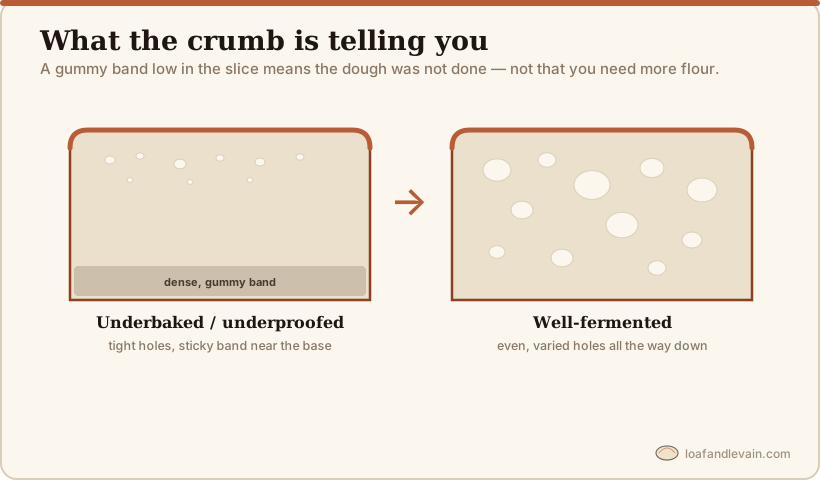
This is the gummy-specific diagnostic. If your loaf is dense rather than wet — tight, heavy, closed crumb but otherwise dry — that's a different problem with a different cause list, and the 12-cause dense sourdough guide walks through it properly. Here we stay focused on the one symptom: a damp, smeary, undercooked-feeling strip in the crumb.
What "gummy" actually means
Gummy crumb is dough that hasn't fully transitioned from gel to bread. During baking, starch granules absorb water and gelatinise into a set, sliceable structure. When that process is interrupted — not enough heat reaches the centre, or the gluten couldn't hold the gas long enough to stay open — the crumb stays in its wet, gel-like state. The result is a damp, doughy strip, usually at the bottom of the loaf where heat takes longest to penetrate.
The key distinction: gummy is a moisture-and-doneness problem, not a density problem. A loaf can be light and well-risen and still have a gummy band at the base. So before you change anything in your recipe, separate the two symptoms in your head. Gummy = wet and smeary. Dense = heavy and tight. They overlap, but they point you in different directions.
Hydration is rarely the ROOT cause
This trips up almost everyone. Bread at 85% hydration can have a perfect, dry, open crumb. Bread at 70% hydration can come out gummy. The water percentage on its own does not make a loaf gummy — what matters is whether that water got driven out and set during the bake.
Hydration is rarely the root cause. It's an amplifier. High hydration makes every other mistake — short bulk, underbake, cutting warm — show up faster and worse, because there's more water to deal with. So if you're chasing a gummy loaf by dropping hydration, you're usually treating a symptom. Fix the fermentation and the bake first; only then ask whether the dough was carrying more water than your oven could finish.
The three causes that explain most gummy loaves
Run these in order. The vast majority of gummy crumb traces to cutting the loaf warm, underbaking it, or getting the proof wrong — and those three together cover almost every case.
Cut too early (the zero-effort fix)
A loaf cut while still warm reads as gummy even when it's perfectly baked. The crumb is still hot, steam is still condensed in the structure, and your knife smears it. The same loaf, cut at room temperature, will read as soft and bouncy.
Wait at least an hour for a standard wheat loaf, and a full 12–24 hours for dense rye (see the rye sourdough rules for why rye sets so slowly). This is the easiest fix in baking. Set a timer, walk away, and rule it out before you blame your technique.
Underbaked (verify with a thermometer)
A loaf that hits the visual signs of doneness — deep colour, hollow knock — is often still underbaked inside. Sourdough crumb needs an internal temperature of 96–99°C (205–210°F) for the starch to fully gelatinise and set.
Do this once: push an instant-read thermometer through the bottom of the loaf into the centre the moment it comes out. Under 96°C means the centre never finished cooking, no matter how dark the crust looks. Give it 5–10 more minutes with the lid off, and use that reading to calibrate every future bake. An undersized oven, a too-dark crust forcing you to pull early, or a very large loaf all push you toward this failure.
Proof was off — and it's DOUGH temperature, not room temperature, that drives it
Both under- and overproofing produce gummy crumb, and they look different:
- Underproofed: the dough went into the oven without enough gas. The crust sets, the crumb behind it can't catch up, and you get a tight gummy band. Tell-tale sign: dense, pale loaf, little oven spring, few large holes.
- Overproofed: bulk ran too long, the gluten broke down, the dough couldn't hold gas, and oven spring failed. Tell-tale sign: a flat loaf, big bubbles right under the crust ("flying crust"), dense gummy crumb below.
The mistake almost everyone makes is timing bulk by the clock and the room thermometer. It's the dough temperature that drives fermentation speed, and dough usually runs warmer than the air because mixing adds friction heat. A 22°C kitchen often means 24°C dough. The canonical relationship: bulk time scales by about 2.2× for every 8°C cooler (and to roughly 45% for every 8°C warmer). Reference point — about 5 hours at 24°C dough with 20% starter. Measure the dough with a probe, not the wall, and feed that number into the bulk-fermentation-by-temperature guide or the calculator to get the right window for your kitchen.
To fix underproofing, extend bulk by 1–2 hours or raise inoculation by 5%. To fix overproofing, shorten bulk, drop inoculation by 5%, or move the dough somewhere cooler. Track rise visually and aim for a 65–75% volume increase from the moment salt went in.
The full symptom map
When the three big causes don't explain it, match what you actually see to the table below. Each row is a distinct gummy signature.
| Symptom you see | Most likely cause | Fix |
|---|---|---|
| Wet smear only when cut warm; fine once cooled | Cut too early | Wait 1+ hour (12–24 h for rye); cut cooled |
| Gummy centre, dark crust, dense feel | Underbaked core | Bake to 96–99°C internal; add 5–10 min lid off |
| Tight pale crumb, little oven spring | Underproofed (cold or short bulk) | Extend bulk 1–2 h or +5% inoculation; measure dough temp |
| Flat loaf, big holes under crust, gummy below | Overproofed | Shorten bulk, −5% inoculation, cooler spot |
| Pale matte crust, compact gummy interior | Not enough steam | Bake covered 20 min, then uncover to brown |
| Gummy with 30%+ whole grain at white-flour numbers | Recipe wrong for the flour | +5–8% hydration, shorten bulk 15–20% |
Steam and whole-grain flour: the two situational causes
Insufficient steam matters mostly for open baking on a stone. Without a steam source the crust sets before the loaf can expand, the interior compacts, and you get a pale, matte crust over a gummy centre. A Dutch oven traps its own steam and sidesteps this entirely — bake covered for the first 20 minutes, then uncover to brown.
The recipe is wrong for the flour is the other one to watch. Whole-grain flours absorb more water and ferment faster than white flour. Take a 75% hydration recipe written for bread flour, swap in 50% whole wheat at the same hydration, and you'll often get gummy results: there isn't enough water to hydrate the bran, and bulk runs ahead of your schedule. For 30%+ whole grain, raise hydration 5–8% and shorten bulk 15–20%. The whole-wheat sourdough guide has the full conversion math.
A diagnostic checklist
Before changing your recipe, run through this in order:
- Did you cut into it warm? If yes, retest with a fully cooled loaf next time. This alone resolves a huge share of complaints.
- What was the internal temperature at bake-out? Under 96°C means bake longer.
- Was the crumb tight and pale, or flat and big-bubbled? Underproofed vs overproofed have opposite fixes.
- What was the dough temperature during bulk — not the room? Probe it, then compare predicted vs actual bulk duration.
- Did you bake covered? If not, try 20 minutes covered then uncovered.
- What flour did you use? Whole-grain blends need their own numbers, not white-flour figures with whole wheat dropped in.
I keep a cheap probe thermometer clipped to the oven door handle so there's no excuse to skip step 2 — it's the check bakers most often talk themselves out of, and it's the one that ends the most arguments with a loaf.
Common questions
Is gummy crumb dangerous to eat?
No — it's underdone in texture, not unsafe. A gummy band is just starch that didn't fully set, plus trapped moisture. It won't taste great and it's hard to slice cleanly, but it's not a food-safety problem. Toasting a gummy slice drives off some of that moisture and makes it more palatable.
How is gummy different from dense?
Gummy is wet and smeary — your knife drags and the crumb feels like paste. Dense is heavy and tight — a closed crumb that's still dry to the touch. A loaf can be one, the other, or both. If yours is dense but not wet, the dense sourdough guide is the right place to look.
Can I rescue a gummy loaf after it's baked?
Partly. Slice it and toast the slices, or cut it open and return the halves to a 160°C (320°F) oven for 10–15 minutes to drive out moisture and finish setting the centre. It won't have the crumb you wanted, but it becomes good toast and excellent breadcrumbs. The real fix is in the next bake, not this one.
Why is only the bottom gummy?
Heat reaches the base last, especially in a Dutch oven sitting on a single rack. The bottom centimetre is the coldest part of the loaf during the bake, so it's the first place to stay under-set if the bake is short. Bake a few minutes longer, move the rack down, or rest the Dutch oven on a preheated stone to push more heat into the base.
My starter is healthy and I still get gummy bread. Why?
A strong starter rules out one underproofing cause, but not the others. You can still cut too early, underbake, overproof, or skip steam with a perfect starter. Work the checklist above in order — most "but my starter is fine" cases turn out to be a warm cut or an unmeasured internal temperature.
Does sourdough get gummy faster than yeasted bread?
It can feel that way because sourdough crumb holds moisture longer and is often baked wetter and at higher hydration. The mechanism is identical to any bread, but the higher water and the slower-setting acidified crumb mean sourdough is less forgiving of an early cut or a short bake.
Stop misreading the crumb
Gummy crumb is the failure that's easiest to misdiagnose because two completely free checks resolve most of it: wait for the loaf to cool, and probe its centre at bake-out. Make those two non-negotiable for the next five loaves — every cut fully cooled, every bake confirmed at 96°C or above — and you'll find that what looked like a fermentation mystery was usually just impatience and an unverified oven. Once those are ruled out, a genuinely gummy loaf is telling you something specific, and the table above will name it.