You've probably read that you should autolyse your dough for 30 minutes, an hour, maybe overnight. Then someone tells you autolyse is pointless and fermentolyse is better. Both camps are partly right, and the difference comes down to timing: how much water hits the flour, when the starter shows up, and how long the flour's enzymes get to work before fermentation acidifies the dough and slows them down.
What each one actually is
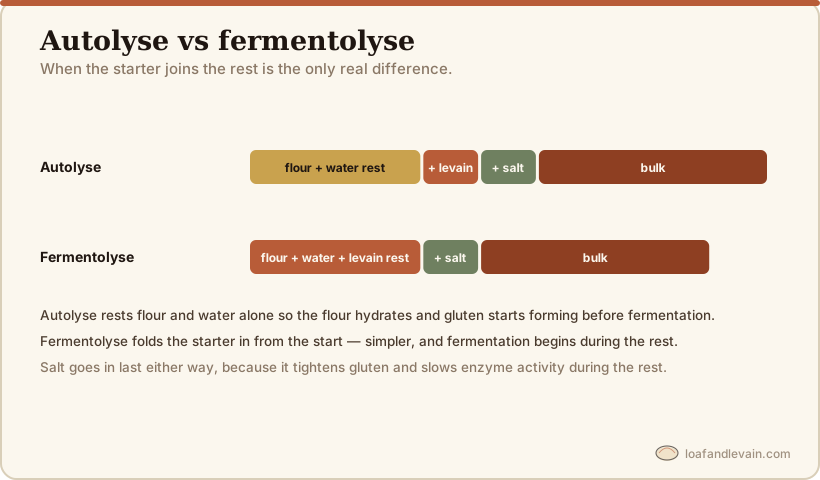
Autolyse is flour and water only. No starter, no salt. You mix until there's no dry flour left, then rest. Raymond Calvel coined the term in 1974 to fix the over-oxidized, flavorless baguettes that came out of high-speed industrial mixing. The rest lets the flour fully hydrate and gives its enzymes — mainly amylase and protease — time to work before any further mixing develops the gluten.
Fermentolyse adds the starter at the same time as the flour and water. Salt is still held back. You rest, then add salt later and start bulk. It's a shortcut: you get hydration and some enzymatic activity, but fermentation is running from minute one.
The "salt later" rule holds for both because salt tightens gluten and slows protease. You want the flour soft and extensible during the rest, then salt to firm it up afterward.
The math: enzymes vs acid
Flour contains amylase, which breaks starch into sugars (food for the yeast, and browning later), and protease, which snips proteins into shorter chains and makes the dough more extensible. Both enzymes are happiest in roughly neutral-to-slightly-acidic conditions — close to the pH of a plain flour-and-water dough, which sits around 6.
Add starter, and fermentation starts pulling the pH down. The exact curve depends on your starter, your inoculation, and the temperature, so treat these as approximate:
- At 100% hydration starter and 20% inoculation, a dough's pH typically drifts from roughly 6 toward roughly 5 over a couple of hours at 24°C (75°F) — faster if you're warmer, slower if you're cool.
- As the dough acidifies past about pH 5, protease activity slows noticeably. Keep dropping and it slows more sharply. It never fully switches off, but in a well-acidified, fermenting dough it's no longer the dominant force.
That's the whole tradeoff in one line. Pure autolyse keeps the dough in the enzyme-friendly zone longer. Fermentolyse trades some of that enzyme time for an earlier start on fermentation. Neither is better in the abstract — it depends on your flour.
How long does each actually need?
For autolyse, the useful range:
- 20-30 minutes: full flour hydration, more extensible gluten. The minimum worthwhile rest.
- 1-2 hours: noticeable protease activity. The dough feels slacker and smoother.
- 4+ hours: protease has done real work. The dough can feel sticky or weak, especially with lower-protein flours (10-11%).
- Overnight (8-12 hours, refrigerated): only with strong flour (12.5%+) and cold to suppress the wild yeast and bacteria already on the flour. Otherwise the dough sours and weakens before you've added a thing.
For fermentolyse the window is shorter, because the clock is now the starter:
- 30-60 minutes is standard. Long enough to hydrate the flour and let enzymes work briefly, short enough that the dough hasn't acidified much.
- Beyond about 90 minutes at room temperature with a 15-20% inoculation, you're effectively just running an unsalted bulk — which weakens gluten through prolonged protease activity in actively fermenting dough.
Side by side
| Autolyse | Fermentolyse | |
|---|---|---|
| What's in the rest | Flour + water only | Flour + water + starter |
| What's resting | Hydration + enzyme action, no fermentation | Hydration + enzyme action + early fermentation |
| Typical duration | 20 min to 2 h (overnight only with strong flour) | 30-60 min |
| Main benefit | Longest time in the enzyme sweet spot; maximum extensibility | One fewer step; earlier ferment; gentler on weak flour |
| Main risk | Over-softening weak or whole-grain flour | Acidifying before the flour is fully hydrated |
| Best for | Strong white flour, high hydration, open-crumb hearth loaves | Lower-protein flour, whole grain, simpler timelines |
When to pick which
Reach for autolyse when:
- Your flour is high-protein (12.5%+) and you want more extensibility.
- You're chasing an open crumb — baguettes, ciabatta, hearth loaves.
- You want to separate hydration time from fermentation time for scheduling.
- You're working high hydration (78%+) and need the flour to drink fully before anything else goes in.
Reach for fermentolyse when:
- Your flour is weaker (10-11.5%) and a long autolyse would degrade it. This is also why whole-wheat doughs usually do better with fermentolyse or a very short autolyse — the bran enzymes are already abundant, and acidity helps protect the structure against them.
- You want a streamlined timeline: one rest, then bulk.
- You're baking warm, where the dough acidifies fast anyway, so a long enzyme-only rest buys you little. In a hot kitchen, summer timing already compresses everything.
A worked example
Say you're mixing 1000g flour at 78% hydration, 20% starter, 2% salt, in a kitchen at 24°C (75°F).
Autolyse path:
- Mix 1000g flour + 760g water (hold back 20g). Rest 1 hour.
- Add 200g starter, then 20g salt with the 20g reserved water. Mix.
- Bulk ferment.
Fermentolyse path:
- Mix 1000g flour + 760g water + 200g starter. Rest 45 minutes.
- Add 20g salt with 20g reserved water. Mix.
- Bulk ferment — and count that 45 minutes as part of it.
Both land at shaping at about the same wall-clock time. With a 20% inoculation at 24°C (75°F), the canonical bulk reference is around 5 hours measured from when the starter joins the dough — so the autolyse loaf bulks ~5 hours after step 2, while the fermentolyse loaf is effectively ~45 minutes into that same clock before you even add salt. If you want the exact timing for your dough temperature and inoculation, the bulk-fermentation-by-temperature guide and the calculator handle the arithmetic — including the Q10 shift of roughly 2.2x for every 8°C.
Crumb differs only slightly. Autolyse loaves often show a hair more openness; fermentolyse loaves can carry marginally more flavor depth from the longer cumulative ferment. If your loaves are coming out dense either way, the method is rarely the culprit — start with dense-crumb troubleshooting instead.
One honest caveat from my own bench: for everyday 20-30% whole-grain blends I rarely autolyse at all anymore. The difference between a 30-minute fermentolyse and a careful autolyse is real but small, and on a busy bake day the simpler path wins more often than the textbook one.
Common questions
Do I need to autolyse at all?
No. Plenty of excellent bread is made with neither method — everything mixed at once, including salt. Autolyse and fermentolyse are tools for extensibility and scheduling, not requirements. The weaker your flour and the warmer your kitchen, the less a long rest helps.
Can I add salt during the autolyse?
You can, and some bakers do for a firmer dough, but then it isn't really an autolyse — it's just a rest. Holding salt back is the whole point: it keeps the gluten loose and lets protease work. Add salt when the enzyme-friendly rest is over.
Why does my dough get sticky and slack after a long autolyse?
Protease has over-softened it. This shows up fastest with lower-protein or whole-grain flours. Cap the autolyse at 30-45 minutes for those flours, or switch to fermentolyse so acidity reins the enzymes in earlier.
Is overnight autolyse worth it?
Only with strong flour and refrigeration. At room temperature the wild microbes on the flour ferment it overnight whether you wanted them to or not, and you'll have a slack, sour, pre-bulked dough by morning. Cold suppresses that — see cold retard vs same-day for how temperature governs these long rests.
Does fermentolyse change my bulk timing?
Yes — count the rest as part of bulk. A 45-minute fermentolyse is 45 minutes of fermentation you've already spent, so subtract it from your bulk target rather than adding it on top.
Which one is better for whole wheat or rye?
Fermentolyse or a very short autolyse. High-extraction flours come loaded with enzymes, so they don't need extra protease time and can suffer from it. The acidity from an early ferment actively protects the structure — which is doubly true for rye, where controlling enzymes is the entire game.
Let your own bench settle it
Pick a method and run it across three identical bakes — same flour, same hydration, same schedule — and change nothing else. The method only matters relative to your flour and your room, so a single comparison on your own bench tells you more than any rule here. If your flour is over 12.5% protein and you want a more open crumb, start with a one-hour autolyse; if it's under 12% or full of bran, start with a 45-minute fermentolyse. Then let the crumb, not the internet, settle the argument.