The cold retard — that 12 to 36-hour rest in the fridge between final shaping and baking — is one of the most-asked-about steps in sourdough. Some bakers swear it's essential. Others skip it entirely. Both groups make great bread. The truth is that retard is a tool, not a rule, and knowing when to reach for it matters more than knowing how long it "should" be.
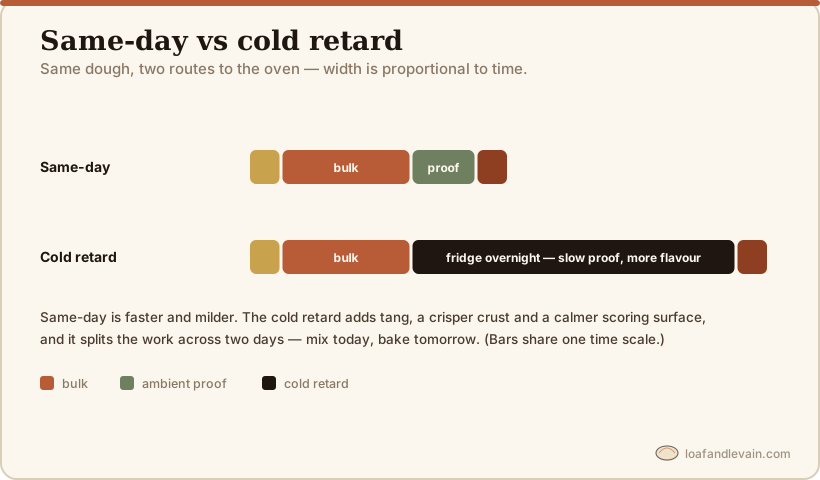
What cold retard actually does
When shaped dough goes from a 22°C kitchen into a 4°C fridge, fermentation slows down hard — but it doesn't stop. The same Q10 ≈ 2.2 rule that governs bulk fermentation by temperature applies here: roughly a 2.2× change in rate for every 8°C. Drop from 22°C to 4°C — an 18°C fall — and you slow fermentation by about 2.2^(18/8), which works out to roughly 6× (5.9×, to be exact). You'll see claims as high as 10× elsewhere, and yeast does fall off its own cliff below about 10°C, but for planning a home bake, "about six times slower" is the honest number to schedule around.
What changes in the dough during those hours:
- Flavour shifts toward sour. Yeast produces less CO2 in the cold, but the lactic and acetic acid bacteria keep ticking over, so the acid-to-gas ratio rises. A 24-hour retard tastes more sour and more layered than a 12-hour one — and the balance leans acetic (sharper, vinegary) the colder and longer you go.
- Scoring gets clean. Cold dough holds a blade mark crisply where warm, slack dough drags and tears. This alone converts a lot of bakers. See scoring sourdough for why a firm, cold surface cuts so much better.
- The crust browns deeper. More acid and more residual sugar in the cold dough means faster caramelisation, so retarded loaves take on a darker, redder crust in the same oven time.
- Your schedule uncouples from the dough. You can mix Saturday afternoon and bake Sunday morning instead of standing at the oven near midnight.
One honest correction worth making, because it gets repeated as gospel: people often say the fridge "lets enzymes break down the flour for flavour." Enzyme activity at 4°C is sluggish — those reactions also slow with temperature. What genuinely softens a long-retarded dough is the combination of continued slow acidification and the simple fact that the gluten network sits fully hydrated under its own weight for a day or more. Cold hydration plus time weakens the dough more than enzymes do at fridge temperature.
Retard duration at a glance
The same recipe behaves quite differently depending on how long it sits cold. Here's what to expect across the common windows, assuming the loaf was properly proofed before it went in:
| Retard time | Flavour | Oven spring | Scoring ease | Best use |
|---|---|---|---|---|
| 0h (same-day) | Mild, bright, wheaty | Good, but spreads if slack | Hardest — warm dough drags | Bread today; very wet doughs; ciabatta/focaccia |
| 12h | Lightly sour, balanced | Strong — cold dough, sharp spring | Easy — firm and cold | The home-baker default; mix one day, bake the next |
| 24h | Clearly sour, complex | Strong, tall rather than wide | Easiest — cuts like clay | Maximum flavour without much risk |
| 36h | Sharp, acetic-leaning | Starts to fade; can spread | Easy but edges may tear | Specific sour breads; buying schedule flexibility |
Past 36 hours you're into specialist territory — the flavour tips from "complex" to "sharp," and the structure slowly gives. For most kitchens, 12–24 hours is the whole useful range.
When same-day bake is the right call
Skip the retard when:
- You want the bread today. Same-day is roughly 8–10 hours from feeding the starter to slicing, against 24–36 for a retard.
- It's a very high-hydration dough you're worried about. Some slack, wet doughs flatten over a long cold rest. A short room-temperature final proof before baking gives them less time to spread sideways. If yours keeps coming out flat or wet inside, the cause is usually upstream — see why sourdough turns gummy and fixing dense sourdough.
- You're baking ciabatta, focaccia, or pan de cristal. These styles want active fermentation right up to the oven. A retard works, but it isn't traditional and it isn't an improvement.
- You're chasing a bright, mild loaf in summer. A short bulk and a brief proof give a fresh, gently sour bread that a lot of people prefer to the deep tang of a long retard.
To plan one, set retard to 0 in the schedule calculator — it lays out a 1–2 hour room-temperature final proof after shaping, then straight into the hot oven.
When retard is worth the wait
Reach for a 12–24 hour retard when:
- You want to bake in the morning, not at midnight. This is the original reason home bakers started retarding at all.
- You want more sour, more complex flavour. Twenty-four-plus hours develops noticeable tang even from a mild starter.
- You want the easiest scoring of your baking life. Cold dough is the single biggest scoring upgrade available to a home baker.
- You're baking around a busy life. A shaped loaf can sit at 4°C for 12–36 hours, so you bake when it suits you rather than when the dough demands.
- You want maximum height. Cold dough meeting a hot Dutch oven creates a steep temperature differential that drives a tall, dramatic spring. Same-day loaves often spread wider; retarded loaves climb.
A 12-hour retard is the sensible default: it's the shortest cold rest that delivers every one of these benefits before the dough starts to deteriorate.
How to tell a retarded dough is ready
You don't need to "warm the dough up" before baking, despite common advice. Take it straight from the fridge, score it cold, and drop it into the preheated Dutch oven with the lid on — the temperature shock is part of what drives oven spring.
The check that matters happens before the fridge. As you put the shaped loaf away, do a poke test on the shaped dough: press a floured finger about 5 mm in. The dent should spring back slowly and leave a slight depression. Spring back fully and fast, and it needs more room-temperature proof before it goes cold. Don't spring back at all, and it's already over-proofed — bake it now, same-day, and skip the retard entirely.
Seasonal retard, by climate
Your kitchen makes the same retard behave differently across the year, because the dough's starting point changes. In a cold-house winter the dough often goes into the fridge under-fermented, so a 12-hour retard can act partly as a slow finish to bulk rather than a pure flavour rest — see winter sourdough for handling cold-kitchen schedules. In summer the opposite risk applies: dough that's run warm and fast can over-ferment quickly even before it cools, so it pays to retard earlier and watch it more closely — summer sourdough covers taming a fast, hot ferment. The retard length on a recipe card assumes a roughly 22–24°C kitchen; adjust your pre-fridge proof, not just the cold time, when your season is far from that.
Letting the calculator do the timing
This is where a retard earns its keep: the schedule calculator works backwards from your bake-out time. Set the finish (say Sunday 09:00), set retard to 12, 16, 24, or 36 hours, and it tells you when to mix, when to fold, when to pre-shape, and when the loaf goes cold. A 09:00 bake with a 24-hour retard means starting the previous afternoon — but the hands-on labour across that whole window is maybe 30 minutes. The fridge does the rest. If you also need the dough to land at the right temperature when you mix, the DDT water-temperature formula gets you there.
Common questions
Does cold retard make bread more sour?
Yes, and predictably so. In the cold, yeast slows more than the acid-producing bacteria, so the dough keeps accumulating acid while producing little gas. Longer and colder both push it more sour, with the balance tilting toward sharp, vinegary acetic acid the longer it sits. Twelve hours reads as "balanced," 24 as "clearly sour," 36-plus as "sharp."
Do I need to bring retarded dough to room temperature before baking?
No. Bake it straight from the fridge. Cold dough scores more cleanly and the temperature shock against a hot Dutch oven improves spring. Warming it up first mainly costs you both advantages and risks over-proofing on the counter.
How long can dough stay in the fridge before it's too far gone?
For most home doughs, 12–24 hours is the comfortable range and 36 hours is the practical ceiling. Beyond that the flavour turns sharply acetic and the gluten — fully hydrated and sitting under its own weight — slackens, so the loaf tears at the score and spreads in the oven. If you need a longer window, retard colder (closer to 2–3°C) and use a slightly stiffer dough.
Can I retard the bulk instead of the shaped loaf?
You can, and some bakers prefer it. Retarding during bulk slows the whole ferment and gives flavour without firming up a shaped loaf, but you then proof and shape from cold the next day. Retarding the shaped loaf is more popular at home because it bundles the flavour gain with bake-ready, easy-to-score dough. If you go the bulk-retard route, lean on your bulk timing to judge how far the cold ferment has actually travelled before you shape.
My retarded loaf came out flat — what went wrong?
Usually one of three things: the dough was already over-proofed before it went cold (the poke test springs back not at all), the hydration was too high for a long cold rest, or it sat past 36 hours and the structure gave out. Shorten the pre-fridge proof, drop hydration a few points, or pull it earlier.
Is same-day bread worse than retarded bread?
No — just different. Same-day loaves are milder, brighter, and wheatier, and they can have a beautifully open crumb. Retarded loaves are more sour, more complex, taller, and easier to score. Plenty of bakeries sell both. Match the method to the loaf you actually want to eat.
Pick the retard by the loaf you want, not the calendar
Decide backwards from the bread on your table. If you want a bright, mild crumb to eat the same evening, mix in the morning and skip the fridge. If you want a tall, tangy, dark-crusted loaf with a crisp ear and the easiest scoring you'll ever do, shape it, give it 12 to 24 hours cold, and bake it straight from the chill. The retard isn't a rite of passage — it's a dial, and the right setting is whichever one produces the loaf you were hungry for when you started.