The stretch-and-fold technique replaces kneading in sourdough. You don't develop the gluten by working the dough on a counter for ten minutes; you develop it by gently lifting and folding the dough over itself a few times during the first half of bulk fermentation. Done right, it's the easiest dough-handling technique in baking. Done wrong, or skipped, it's behind half the dense and flat loaves home bakers post about.
Here's what's actually happening, how many folds you need, when to stop, and how to scale folds to your flour, your hydration, and your kitchen temperature.
What folding does
Mixing combines flour and water and starts forming gluten — long chains of protein that trap fermentation gas. But the gluten formed during mixing alone is disorganised. The strands are tangled, weak, and uneven.
Folding aligns them. Each fold stretches the dough, lengthening the protein chains and pulling them parallel. Repeated folds layer aligned gluten on aligned gluten. After three or four sets, the dough has organised structure capable of holding its shape, expanding upward instead of outward, and trapping gas in a way that produces an open crumb.
You're not forcing strength into the dough by kneading. You're letting it develop strength on its own and just helping it organise.
How to do a stretch-and-fold
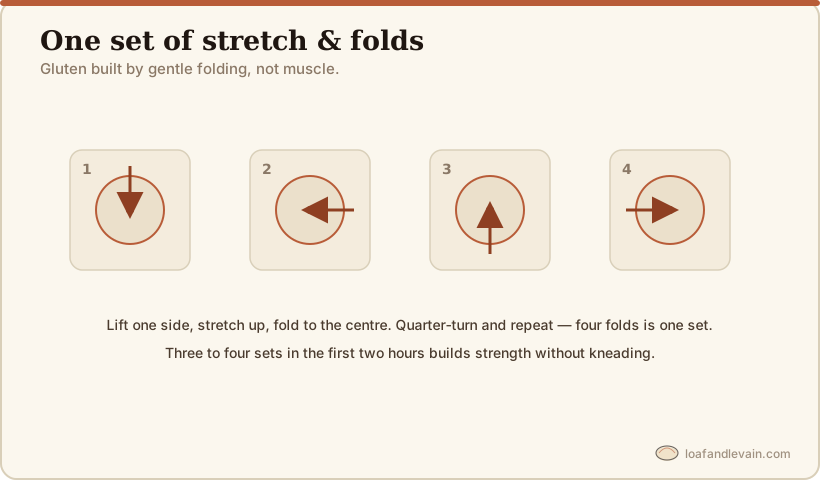
Wet your hands lightly. Reach under one side of the dough, lift it up until it stretches as far as it'll go without tearing, and fold it over the centre. Rotate the bowl 90 degrees. Repeat — three more times for a complete set of four corners. Cover the bowl and walk away.
That's one "set." Most schedules call for three to four sets during the first two hours of bulk fermentation. I do all of mine right in the bulk container with a wet hand and never touch a counter — fewer dishes, and the dough never sticks.
When to do them — and why timing beats kitchen temperature
The standard schedule, with timing measured from when you mixed in the salt and started bulk:
- Set 1: 30 minutes in. The dough is sticky and the folds feel rough. Normal.
- Set 2: 60 minutes in. Noticeably smoother. Gluten is starting to organise.
- Set 3: 90 minutes in. Smooth, supple, holds shape between folds.
- Set 4: 120 minutes in. Should feel taut, almost springy, holding the folded shape for a full minute before relaxing.
After the last set, leave the dough alone for the rest of bulk.
Here's the part most schedules get wrong: the folding window stays roughly the same length regardless of how warm or cold your kitchen is. Gluten organisation isn't a fermentation reaction — it's mechanical, plus the dough's own relaxation between folds, and that relaxation happens on a clock measured in tens of minutes whether the room is 18°C (64°F) or 28°C (82°F). What kitchen temperature changes is the total length of bulk: a warm 26°C (79°F) dough might finish bulk in roughly four hours while a cool 20°C (68°F) dough takes seven or more (the full curve is in bulk fermentation by temperature). But your folds still belong in the first two hours either way.
So don't stretch your folds out to match a long cold bulk. If bulk is going to run seven hours in a cool kitchen, you still want all your folds done by hour two and then five hours of undisturbed rise. Folding into hour three or four disrupts the gas already accumulating in the structure, and that's true at every temperature.
How many folds is "right" — by hydration
Most home recipes call for four sets. That's the workable default, but the right count depends on hydration and on how strong your flour is. Wetter dough is slacker and needs more sets to build the same structure; drier, stronger dough gets there faster.
| Hydration band | Recommended sets | Fold type | Timing |
|---|---|---|---|
| 60–65% (stiff) | 2 sets | Standard stretch-and-fold | At 30 and 60 min |
| 65–72% | 3 sets | Standard stretch-and-fold | At 30, 60, 90 min |
| 72–80% | 4 sets | Standard stretch-and-fold | At 30, 60, 90, 120 min |
| 80–85% | 4–5 sets | Coil folds (gentler) | Every 30 min through ~150 min |
| 85%+ (very wet) | 5–6 sets | Coil folds | Every 30 min through ~180 min |
The signal isn't really the number — it's the dough. You stop when it's smooth, glossy, holds its shape when poked, and resists being pushed out of shape. If a 78% dough still feels slack after four sets, add a fifth. If a 68% dough feels strong after two, you can stop early. The table is a starting point; the dough has the final say. (For why these hydration numbers behave the way they do, see hydration explained.)
"Bread flour" vs "strong bread flour" — same thing
A quick clarification, because the labels cause real confusion across recipes. "Strong bread flour" is the British term for what Americans simply call "bread flour." Both mean a high-protein wheat flour, roughly 12–14% protein, milled for the long gluten development that bread needs. "Strong" refers to gluten strength, not anything added. So when a UK recipe says strong white bread flour and a US recipe says bread flour, they're calling for the same product, and the fold counts above apply to both.
What genuinely behaves differently is plain / all-purpose flour (around 10–11% protein). It develops less structure, so a dough made with it stays slacker for longer and often wants an extra set compared to the same hydration in bread flour. If your folds feel like they're not "taking," check whether you're actually using bread flour — that's a more common culprit than fold technique.
Stretch-and-fold vs coil fold
The basic stretch-and-fold works well up to about 75% hydration. Above that, the dough is wet enough that lifting it from underneath drags through the mass and tears it.
For wetter doughs, switch to coil folds: with wet hands, lift the dough from the centre straight up, letting the two ends drape down and tuck under as the middle rises. Set it down, rotate 90 degrees, and lift again. The dough folds under itself — same alignment, far less pulling and tearing. Most recipes for very high-hydration loaves (85%+ ciabatta, pan de cristal) specify coil folds for exactly this reason.
What if you skip folds entirely
Skip folds in a 75% country loaf and you get a flat, dense, structurally weak loaf. You can feel it: the crumb won't open and the shape won't hold. Fermentation still works fine — but without organised gluten, gas escapes sideways instead of pushing the crumb upward. This is one of the quiet causes behind dense sourdough that bakers blame on their starter.
For very low-hydration doughs (under 60%) you can sometimes get away with no folds, because the dough is stiff enough to hold structure on its own. For nearly every sourdough you'll actually bake, fold.
Folding and bulk timing
Folding doesn't speed up or slow down fermentation. It changes the structural quality of the bread, not the chemistry. So if your dough finished at 24°C with 20% starter, bulk runs about five hours whether you fold three times or five — the canonical curve doesn't move because you folded.
What folds do change is when bulk looks done. A well-folded dough holds gas and shows visible rise sooner, so you might hit the 50% rise mark a touch earlier than the clock predicts. A poorly folded dough leaks gas as fast as it makes it and may never visibly reach 50% rise even at the correct proof time — which leads people to over-ferment, chasing a rise the structure can't hold. If you judge by the float test or by feel rather than volume alone, weak folds will fool you less.
Common mistakes
Folding too late. All your sets belong in the first two hours of bulk, regardless of how long total bulk will run. Folding at hour three or four breaks down accumulating gas structure.
Folding too aggressively. Stretch until the dough is about to tear, not past it. Tearing breaks the gluten you're trying to build.
Stretching folds out to match a long cold bulk. A cool kitchen lengthens bulk, not the folding window. Keep all folds in the first two hours.
Skipping a set because the dough already looks good. Tempting at the 90-minute mark, but the dough you get from a full schedule is noticeably stronger than one set short.
Using a dry counter for high-hydration coil folds. The dough sticks and tears. Wet hands, fold in the bowl.
Folding after bulk has effectively ended. Once the dough is at 65–75% rise, pre-shape and bench rest come next, not more folds.
Common questions
Can I fold every 30 minutes instead of spacing some out to an hour?
Yes, and for wet doughs (80%+) you should — coil folds every 30 minutes is the standard there. For 70–78% doughs the half-hour vs full-hour spacing barely matters; what matters is that the dough gets 20–30 minutes to relax between sets so each fold actually stretches new structure rather than fighting a tight dough.
My kitchen is cold (18°C). Should I do more folds or spread them out longer?
Neither. Cold lengthens total bulk but not the folding window. Keep the same number of sets in the same first two hours, then let the longer, cooler bulk finish on its own. If anything, a cold dough relaxes more slowly between folds, so err toward the full hour spacing rather than 30 minutes. See winter sourdough for handling a cold kitchen end to end.
How do I know if I've folded enough?
The windowpane idea, adapted: gently stretch a corner of the dough between two sets. Early on it tears almost immediately. By your last set it should stretch thin enough to see light through before it tears, and the whole mass should hold a domed shape when you stop folding instead of slumping flat. That's "enough" — more folds past that point don't add anything.
Does fold count change with whole wheat or rye?
Yes. Whole wheat dough often wants one extra set because bran cuts through gluten as it hydrates, so the structure builds and degrades at the same time — details in whole wheat sourdough. Rye is the opposite extreme: it has almost no gluten to align, so folding does little. For high-rye dough you mix until uniform and skip folds entirely (rye sourdough rules).
Can I overdo it and damage the dough?
Yes, in two ways. Folding past your last scheduled set, deep into bulk, tears apart gas pockets that have already formed. And folding too hard at any stage rips gluten instead of stretching it. More sets early is forgiving; aggressive or late folds are not.
Do folds replace shaping?
No. Folds build structure during bulk; shaping at the end of bulk builds surface tension on a single loaf and sets its final form. They're different jobs at different stages. Folds make the dough strong enough that shaping actually works.
Make the last set count
If you only nail one set, make it the last one. By your final fold the dough has had over an hour to develop, and that's the set that tells you whether bulk is on track: it should come together taut and springy and hold its folded shape for a full minute. If it still spreads and slumps at that point, the dough is either too wet for the fold count you've done — add a set — or your flour is weaker than you thought. Read that last fold honestly and you'll know how your loaf is going to behave long before it reaches the oven.