Hydration is the percentage of water in your dough relative to flour. A 75% hydration dough has 75 g of water for every 100 g of flour. That's it — the math is simple. What's not simple is how dramatically different doughs behave at different hydrations, and why you'd choose one over another.
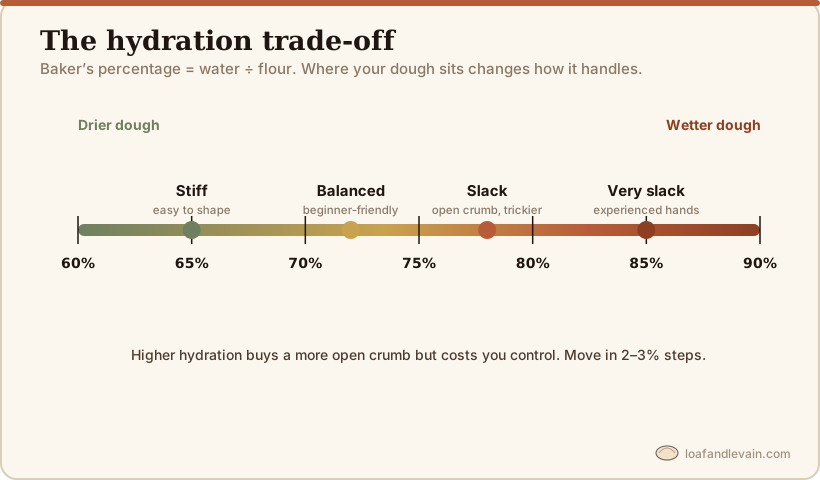
This is the practical guide to picking a hydration that actually matches your skill, your flour, and the bread you want.
How to read a baker's percentage
Hydration is always calculated against total flour weight, so:
- 500 g flour at 75% hydration = 375 g water
- 1000 g flour at 80% hydration = 800 g water
- 300 g flour at 100% hydration = 300 g water (equal weights)
The starter (levain) is usually 100% hydration — equal flour and water — so a recipe with 20% inoculation contributes some additional flour and water that strict bakers count separately. For home baking, the difference is small enough that you can ignore it unless you're chasing competition-level precision. If you want the exact total-hydration figure, the recipe calculator folds the levain's flour and water into the percentage for you.
What changes as hydration goes up
Higher hydration means a more open crumb, a glossier interior, and livelier fermentation activity. It also means stickier handling, weaker shape, harder scoring, and more skill required. Every step up the ladder trades forgiveness for drama.
Here's how the common bands compare before we walk through each one.
| Hydration | Handling | Crumb | Who it suits |
|---|---|---|---|
| 60–65% | Stiff, clay-like, shapes by hand easily | Tight and even, sandwich-style | Beginners, low-protein flour, pan loaves |
| 68–72% | Tacky but firm, holds a strong shape | Moderately open, predictable | First 30 bakes, classic country loaf |
| 75–78% | Sticky, needs wet hands for folds | Open with even walls, glossy | Confident bakers with bread flour |
| 80–85% | Slack at first, demands a bench scraper | Large irregular holes, thin walls | Open-crumb chasers with strong flour |
| 100%+ | Pourable batter, not shaped | Nearly all hole, glassy | Showcase loaves (pan de cristal) |
60–65% — beginner-friendly territory
A 65% dough feels like clay. It's easy to handle, holds shape well, and forgives a lot of mistakes. The crumb will be tight by sourdough standards — small even alveoli, almost like a sandwich loaf. The crust will be crisp but the interior will be on the dense side.
Use this hydration if:
- You're in your first 10 sourdough bakes
- You want sandwich bread
- You're using a flour with low protein (cake flour, all-purpose under 11% protein)
- You're working with a lot of whole grain, which drinks water differently
Recipes: pain de mie, sandwich loaves, brioche-style sourdough, very dense rye breads.
68–72% — the dependable workhorse
This is where a beginner gains real control. The dough is tacky but still firm enough to shape on a lightly floured bench without a scraper. Crumb is open enough to look like "real" sourdough without the chaos of a high-hydration bake. Scoring behaves. If your loaves keep coming out dense, this band is where you diagnose technique, because the water is no longer the variable working against you.
Use this hydration if:
- You're in your first 30 bakes
- You want a classic country loaf appearance
- You're using bread flour (12–13% protein)
- You bake in a Dutch oven
Recipes: country loaf, multigrain, mostly-white sourdough.
75–78% — the sweet spot
This is where most published sourdough recipes live. The dough is sticky enough that you need wet hands for stretch and folds, but it organises into real strength as the gluten develops. A 75% hydration country loaf with bread flour is the most-baked sourdough recipe in the world for a reason: it works, mistakes are forgiven, and results are predictable.
Use this hydration if:
- You can do a confident set of stretch and folds without tearing the dough
- You want an open but structured crumb
- You're using solid bread flour (12.5–13.5% protein)
Recipes: high-end country loaf, mostly-white open crumb, multigrain.
80–85% — the open-crumb push
Now things get interesting. At 80%+ the dough acts more like a wet batter for the first hour, then develops surprising strength as gluten organises during folds. Final shaping is harder — you need confidence and a quick hand. The crumb gets dramatically more open: large irregular alveoli, glossy walls.
Use this hydration if:
- You've bought a bench scraper and you actually use it
- You can do a coil fold without dragging the dough
- You're using strong bread flour (13%+ protein) or T80
- You want that "open crumb" look you see on Instagram
Recipes: high-hydration country loaf, ciabatta, focaccia.
85–95% — advanced territory
These doughs flow. They look like they'll never become bread, then they do, and the result is glossy and full of character. Mistakes punish you — overworked dough turns soupy, underworked dough won't shape, and timing windows are tight.
Use this hydration if:
- You've baked 50+ loaves
- You can read the dough by feel
- You have strong bread flour
- You're after specific rustic styles
Recipes: pan de cristal, very open ciabatta, certain Spanish-style loaves.
100%+ — pan de cristal territory
At equal-weight water and flour, you're not making a shaped loaf anymore — you're making a slab. The dough is poured rather than shaped. The crumb is dramatic: nearly all hole, very thin walls, a glassy interior. These are showcase loaves, not weekday loaves.
The flour question
Hydration doesn't exist independently of flour. The same 80% recipe will be sloppy with 11% protein flour and perfectly handled with 13% protein flour. Whole-grain flours absorb 5–10% more water than white flour because of the bran's surface area. Old flour absorbs less than fresh flour.
Practical translation:
- All-purpose (10–11.5% protein): stay at 60–72%
- Bread flour (12–13.5%): comfortable up to 78%, possible to 82% with technique
- Strong bread flour / T80 (13–14%): comfortable up to 85%, possible higher
- Whole wheat (any): add 5–8% to whatever the recipe says — see the whole wheat guide for the band-by-band targets
- Rye (significant percentage): different rules entirely — keep hydration lower than you'd expect and plan for a denser, stickier dough that ferments faster. See the rye sourdough guide for the full breakdown.
One honest caveat from my own kitchen: the same bag of flour drinks differently in a humid August than in a dry February. I shave a percentage point or two off in summer and add it back in winter, then adjust by feel during the first fold rather than trusting the recipe number blindly.
Use the calculator to convert
If you find a 75% recipe online but your flour can really only handle 70%, the recipe calculator recalculates everything proportionally. Drop hydration to 70% and the water grams update, salt and starter stay at their target percentages, and the total dough weight adjusts. Same for scaling — turn a 500 g recipe into 800 g without doing math. Hydration also feeds the timing model indirectly: a wetter dough ferments a touch faster at the same temperature, which is folded into the bulk-fermentation schedule.
Common questions
How do I adjust an online recipe to a different hydration?
Work from the flour weight, never the water. Multiply total flour by your target hydration to get the new water grams — 500 g flour at 72% is 360 g water. Keep salt at 2% and starter at your usual inoculation, both calculated off flour, so they don't move when water does. Change one variable at a time; if you drop hydration and also swap flour and shorten bulk in the same bake, you won't know which change fixed (or broke) the loaf.
Is hydration the same thing as autolyse?
No, they're unrelated dials that people conflate. Hydration is how much water is in the dough. Autolyse is when you add it — resting flour and water before the salt and levain go in, so the flour hydrates and gluten starts forming on its own. You can run a 65% dough or an 85% dough with or without an autolyse. A rest makes a high-hydration dough easier to handle because more water is bound up before you start folding, but it doesn't change the hydration number itself.
My dough is too sticky to handle. Should I lower the hydration?
Sometimes, but check the order of operations first. Sticky dough at mixing often firms up after gluten develops, so wet hands and a couple of folds may be all you need. Sticky dough at shaping usually means overproofing or weak flour rather than too much water. If you've ruled both out and it's still a battle, drop 3–5% next bake — that's a meaningful change without falling off a cliff. Whole-grain doughs especially keep absorbing water for an hour after mixing, so what feels slack at mix can be fine by the first fold.
Why does higher hydration give a more open crumb?
More water makes the gluten network more extensible, so gas bubbles can stretch into large, irregular alveoli instead of being trapped in a tight matrix. A wetter dough also steams more aggressively in the oven, pushing those bubbles open during oven spring. But hydration alone doesn't deliver an open crumb — without strong gluten development and correct fermentation, extra water just produces a flat, gummy loaf with big random holes near the crust.
Does hydration change my fermentation timing?
A little. Wetter doughs ferment slightly faster at the same temperature because the microbes move more freely through a looser matrix, but the effect is minor next to dough temperature and inoculation. Don't recalculate your whole schedule around a hydration change — set timing by dough temperature using the bulk-fermentation guide and treat hydration as a small nudge, not a main lever.
What hydration should a beginner actually start at?
68–72% with bread flour. It's open enough to feel like genuine sourdough, firm enough to shape on the bench without special tools, and forgiving enough that a slightly mistimed bulk still bakes into good bread. Master that band first; the higher numbers are a skill ceiling, not a starting line.
Match the water to the bread, not the photo
Hydration isn't a leaderboard. A confidently made 72% loaf with a clean ear and even crumb beats a sloppy 85% that flattened during retard into an irregular mess. Decide first what you want on the plate — sandwich slices, an open-crumb country loaf, a glassy pan de cristal — then read backward to the hydration and the flour that get you there. When a band starts feeling boring rather than challenging, that's your signal to add five points of water and climb one rung. Bake the bread you can make well today, and let your hands earn the wetter doughs.