Your starter doubles in 4 hours in July. In January it barely budges overnight. Same flour, same feeding ratio, same jar — but a 16°C (61°F) kitchen ferments at roughly one-third the speed of a 24°C (75°F) kitchen. Cold-kitchen sourdough isn't broken sourdough. It's just slower, and the fix is mostly about understanding how temperature drives fermentation, then nudging the dough toward the conditions it actually wants.
This guide covers what changes below 20°C (68°F), how to find or create warm spots, how to adjust timing and starter quantity, and what to do when your bulk ferment stalls.
Why cold kitchens wreck your timing
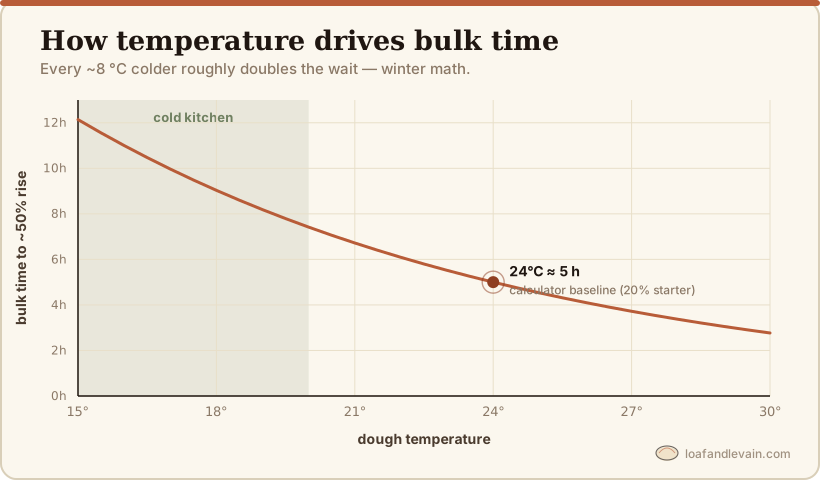
Yeast and lactic acid bacteria are temperature-sensitive in a non-linear way. The rule that governs everything else here: fermentation slows by about 2.2× for every 8°C (about 14°F) you drop — a touch more than halving — so the gap between a 24°C kitchen and a 16°C one isn't small. It's a factor of more than two.
- 26°C (79°F) — fast, often too fast for flavour development
- 24°C (75°F) — the "textbook" sourdough temperature most recipes assume
- 21°C (70°F) — comfortable, predictable, slightly slower
- 18°C (64°F) — bulk may take 9–11 hours instead of 5
- 15°C (59°F) — fermentation crawls; expect 12+ hours or a stalled dough
The other shift is microbial. Cold favours lactic acid bacteria over yeast, so cold-fermented doughs tend to taste tangier with less rise. This is why fridge retards work for flavour but you can't bulk-ferment a dough at 6°C (43°F) and expect it to puff up.
The single most important number in winter baking is the dough temperature — not the room temperature, not the water temperature. If you're not measuring it with a probe thermometer right after mixing, start there. Target a 24–26°C (75–79°F) final dough temperature in winter, and you've already solved half the problem.
Hitting the right dough temperature
In a cold kitchen, water is the only input warm enough to drag the dough up to target, so you run it hot. The arithmetic — how much to subtract for cold flour, a cold room, and mixing friction — is the DDT water-temperature formula, and the calculator does it in one step. The winter-specific point: with flour and kitchen both near 17°C (63°F) and a hand mix (3°C friction), the formula hands you (25 × 3) − 17 − 17 − 3, which lands at 38°C (100°F) water for a 25°C dough. That feels uncomfortably warm on your hand, but it's correct. Don't exceed 40°C (104°F) — above that you start killing yeast on contact.
Where to find warmth in a cold house
You don't need a proofing box. You need a microclimate that holds 24–26°C (75–79°F) reliably.
The oven light trick
In most ovens the interior light alone produces 24–28°C (75–82°F) after 30 minutes with the door closed. Test yours: leave a thermometer in there with the light on for an hour and read the result. If it overshoots, prop the door open with a wooden spoon. If it undershoots, add a mug of just-boiled water for humidity and a few extra degrees.
Other warm spots worth checking
- On top of the fridge (compressor heat) — usually 22–25°C (72–77°F)
- Near (not on) a radiator — measure first, radiator surfaces run 60°C+ (140°F+)
- Inside an insulated cooler with a jar of warm water swapped every few hours
- On top of a router or cable box — genuinely works, around 28–32°C (82–90°F)
- Inside a switched-off microwave with a mug of hot water
I keep my starter on top of the fridge from November onward — it's the one spot in my flat that holds 23–24°C without me thinking about it, and the starter stays predictable all winter.
Build a cheap proofer
A small seed-starting heat mat plus a plastic tub gives you a stable 25–27°C (77–81°F) environment for the price of a couple of bags of flour. Put the mat under the tub, the dough inside, lid on. It's the closest thing to professional proofing you'll get at home for very little money.
Adjusting your starter for winter
A sluggish starter is the most common winter complaint. Three changes help:
Feed warmer water. If you've been using room-temperature water, switch to 30–32°C (86–90°F). This alone often revives a starter that "won't peak."
Increase the feeding ratio temporarily. If you normally feed 1:5:5 (starter:flour:water), drop to 1:3:3 in winter so the starter peaks in a reasonable timeframe. The mechanics of why a smaller ratio peaks faster are in starter feeding ratios. Use it at peak — not 12 hours after peak when it's already collapsed and acidic.
Keep it in a warm spot between feeds. Same locations as above — oven with the light on, top of the fridge, near (not on) a heat source. If a feed isn't peaking at all and you've inherited a neglected jar, reviving a forgotten starter is the faster route back than waiting it out cold.
If your starter is taking more than 8 hours to peak after feeding, it's too cold. Period. Move it.
Adjusting bulk fermentation
This is where most winter loaves go wrong. Bakers follow a 5-hour recipe in a 17°C (63°F) kitchen, shape underproofed dough, and pull a brick out of the oven.
The fix is to read the dough, not the clock. The complete set of done-signs — 50–75% rise, a domed and bubbled surface, jiggle, and the dough pulling from the bowl — plus the temperature-to-time table lives in bulk fermentation by temperature, and it's worth keeping open while you bake.
Here's the winter delta on top of that guide. Using the canonical reference — about 5 hours at 24°C (75°F) with 20% starter, scaling by 2.2× for every 8°C you drop — a cold kitchen lands roughly like this:
| Dough temp | Approx. bulk time (20% starter) |
|---|---|
| 24°C (75°F) | ~5 hours |
| 21°C (70°F) | ~6.5 hours |
| 18°C (64°F) | ~9–10 hours |
| 16°C (61°F) | ~11–13 hours |
So a recipe written for a warm kitchen will routinely double in length at 17–18°C. If you can't commit to that window, move the dough to a warm spot rather than shaping early. Rushing bulk in the cold is the single most common reason for dense winter loaves.
Cold bulk strategy: stretch and folds matter more
When fermentation is slow, gluten development from time alone is also slower. Front-load your structure: do 3–4 sets of stretch-and-folds at 30-minute intervals during the first two hours, then leave the dough alone. This builds strength mechanically instead of relying on enzymatic activity that's also crawling in the cold.
Hydration in the cold
Cold dough holds its shape better than warm dough — gluten is firmer and fermentation isn't degrading it as fast — so winter is when you can comfortably run the wetter end of your range. If you usually bake at 72% in summer, 75–78% is easy to handle in a cold kitchen. The catch is the flour itself: cold winter flour and cold tap water hydrate more slowly, so give a winter dough a longer rest after mixing before you judge whether it needs more water. If you want the underlying logic of why the ratio changes how the dough feels, see hydration explained.
Cold retard considerations
Winter doesn't change retard logic much, but a few notes:
- Your fridge is still 4°C (39°F). The cold kitchen doesn't change that.
- If your shaped dough was underproofed going in (common in winter), it won't catch up much in the fridge. Aim for roughly 80% proofed before retarding.
- Some bakers skip the retard entirely in winter and bake straight from a long ambient cold bulk. The flavour profile is similar. The full trade-off between the two paths is in cold retard vs same-day.
Quick comparison: warming methods
| Method | Temp range | Cost | Stability | Best for |
|---|---|---|---|---|
| Oven with light on | 24–28°C (75–82°F) | Free | Good | Bulk ferment, starter |
| Top of fridge | 22–25°C (72–77°F) | Free | Excellent | Starter, slow bulk |
| Cooler with warm water | 25–30°C (77–86°F) | Free | Fades over hours | Short proofs |
| Seed heat mat + tub | 25–30°C (77–86°F) | Low | Excellent | Everything |
| Dedicated proofer | 24–32°C (75–90°F) | High | Excellent | Heavy bakers |
| Microwave + hot water | 26–30°C (79–86°F) | Free | Fades | Final proof |
Baking the cold-fermented loaf
A winter dough behaves the same in the oven as any other — the doneness target doesn't move with the season. Pull the loaf when the centre reads 96–99°C (205–210°F) on an instant-read probe; lean to the top of that range for wholemeal or rye-heavy doughs that hold more moisture. The crumb feels gummy if you slice a still-warm loaf, so give it a few hours on a rack before cutting. Winter's slow ferment doesn't excuse a short bake.
A practical winter schedule
For a 17–18°C (63–64°F) kitchen, a workable timeline:
- 8:00 — Feed starter 1:3:3 with 32°C (90°F) water, place in oven with the light on
- 14:00 — Starter at peak. Mix dough with warm water targeting 25°C (77°F) dough temperature
- 14:30–16:30 — Three sets of stretch-and-folds at 30-minute intervals, dough in a warm spot
- 16:30–23:00 — Bulk continues until 50–75% rise (watch the dough, not the clock)
- 23:00 — Shape, into banneton, into the fridge
- Next morning — Bake cold from the fridge
If your kitchen is colder than 17°C, extend bulk and consider moving the dough to a heated environment for the entire ferment.
Common questions
Why is my starter not doubling in winter?
It's too cold. A starter at 17°C (63°F) might take 12+ hours to peak and could collapse before you notice. Move it to a 24–26°C (75–79°F) spot — oven with the light on, top of the fridge, or a heat mat — and feed with 30°C (86°F) water. If it still won't double within 6–8 hours after that, the starter itself needs rebuilding with more frequent feeds for a few days.
Can I bulk ferment overnight at room temperature in winter?
In a 15–18°C (59–64°F) kitchen, yes — a long, slow overnight bulk of 10–14 hours works and produces excellent flavour. Use less starter (5–10% of flour weight instead of 20%) so it doesn't overproof while you sleep. Above 19°C (66°F) overnight, you risk an overproofed dough by morning.
Should I use more starter in winter to speed things up?
You can, but it's a trade-off. More starter means faster fermentation but less time for flavour development and less complex acidity. The better lever is to keep the starter percentage normal (15–20%) and raise the dough temperature instead. Only bump starter quantity if you genuinely can't access a warm spot.
My dough is cold after mixing — can I warm it up?
Yes. Put the bowl in a slightly warm water bath, around 30°C (86°F), for 20–30 minutes to bring the dough temperature up. Don't go hotter or you'll cook the outside of the dough. Check the dough temperature again before deciding it's fixed.
Is winter sourdough actually better-tasting?
Often, yes — if you let the slowness work for you. Long, cool fermentations build more complex acid profiles and deeper flavour. The mistake is fighting the cold instead of either embracing the long timeline or properly warming the dough. Pick one and commit to it.
How do I tell an underproofed loaf from one that's just dense because it was cold?
Underproofed loaves have a tight, gummy crumb with large irregular tunnels near the top crust — the dough sprang in the oven but had nothing supporting the air pockets — and they tear rather than slice cleanly. A cold-fermented but properly proofed loaf has an even, slightly tighter crumb than a summer loaf, which is normal and not a flaw. If you're chasing a dense crumb across seasons, fixing dense sourdough ranks the causes.
Let the cold set the clock
Winter baking goes wrong when you run a summer timeline in a January kitchen. Everything you need is measurable: kitchen temperature at the hour you usually mix, dough temperature within two minutes of mixing, and how long the starter takes to peak in its warm spot. Write those three numbers down once this week and the rest follows — the bulk window, the water temperature, the schedule all fall out of them. The cold isn't the problem. Pretending it's still summer is.