A scored loaf opens where you tell it to. An unscored loaf tears wherever the dough is weakest — usually a ragged blowout along the side, sometimes a flat top with no rise at all. Scoring is how you control the explosive expansion in the first 10 minutes of baking, when steam and trapped CO₂ push the crumb upward against a crust that is rapidly setting.
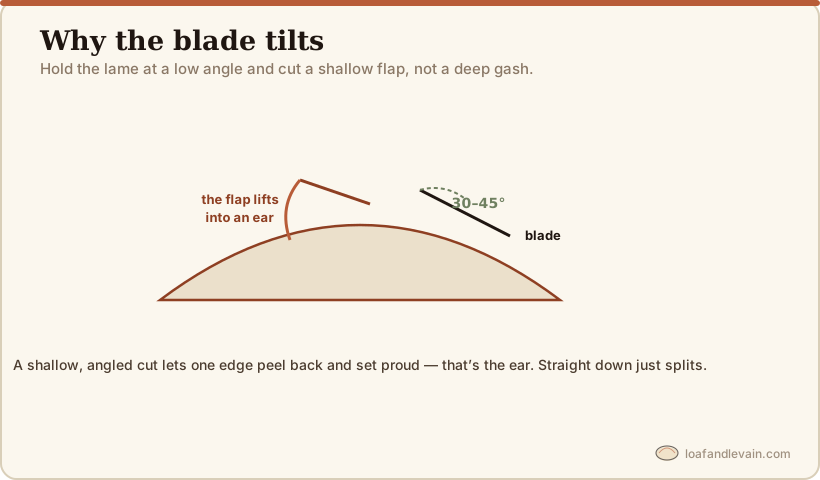
Done well, you get an ear (a raised lip of crust along the cut) and bloom (the dramatic opening and lift around the score). Done poorly, the cut closes back up, the loaf goes flat, or the crust splits sideways. Almost every fix here is mechanical, not mystical — a sharper blade, a colder dough, a shallower angle.
The tools
Use a real lame fitted with a fresh double-edged razor blade. Not a paring knife, not a serrated bread knife, not a butter knife. The blade has to glide through wet dough without dragging. A dull blade snags, deflates the surface, and gives you a closed-up score every time.
Swap blades every 5–10 loaves. They cost pennies. A blade that scored beautifully last week can be dull enough today to ruin a bake, and you will blame your shaping when the real culprit is a tired edge. I keep a little jar of spares next to the oven so there is no excuse not to change one.
A curved blade (the lame bowed into an arc) is the easier starting point for ear cuts — the curve does some of the angle work for you. A straight blade gives more control for fine decorative lines.
What temperature dough scores best
Cold. After a 12–16 hour cold retard at 3°C (38°F), the surface is firm and tacky but not sticky, and the blade slices cleanly instead of dragging through soft, gassy dough. Cold scoring is one of the underrated reasons to retard at all — see cold retard vs same-day bake for when the overnight fridge rest is worth it and when it isn't.
If you are baking same-day without a retard, chill the shaped loaf in the freezer for 20–30 minutes before scoring. The skin firms up just enough to take a clean cut. Warm, slack dough at 24°C (75°F) is the hardest state to score well — the blade tears rather than slices, and the cut closes as the gas escapes.
Angle and depth
There are two cuts and two purposes, and confusing them is the most common scoring mistake.
- Ear cut: hold the blade at roughly 20–30° from the surface, almost parallel to the loaf. This shaves a flap of dough that lifts and curls during oven spring — that flap is your ear. Depth about 6 mm.
- Decorative cut: hold the blade at 90°, straight down. Used for wheat stalks, leaves, and patterns where you want clean lines, not dramatic lift. Depth about 3 mm, deliberately shallower.
Most beginners cut too deep and too vertical. A vertical cut 12 mm deep just opens into a canyon and stays open — no ear, no curl, no lift. A shallow angled cut is what produces the ear, because it leaves a thin shelf of dough that the expanding crumb pushes outward and up.
Scoring patterns at a glance
| Pattern | Blade angle | Depth | Purpose |
|---|---|---|---|
| Single off-centre slash | 20–30° (low) | ~6 mm | One strong ear, maximum bloom in one direction — the batard workhorse |
| Cross / square on a boule | 90° (vertical) | ~6 mm | Even four-petal opening; forgiving of mediocre shaping |
| Wheat stalk | 90° (vertical) | ~3 mm | Purely decorative spine with branches; no structural lift |
| Coil / spiral on a boule | 90° (vertical) | ~3 mm | Showpiece curve that opens gently and forgives a shaky hand |
| Multiple parallel ears | 20–30° (low) | ~5 mm | Several smaller ears across a long loaf; needs strong dough |
The pattern column splits cleanly into two groups: low-angle deep cuts that lift, and vertical shallow cuts that decorate. Mix the two on one loaf and you get the best of both — a single deep ear cut plus a shallow design elsewhere.
The basic patterns in detail
Single slash (learn this first)
One off-centre cut running about three-quarters of the length of the loaf, blade at 30°. This is the classic batard score. It funnels all the oven spring into a single ear and gives you maximum bloom in one direction. If you bake one loaf shape, master this before anything decorative.
Cross or square
Two perpendicular cuts on a boule, vertical rather than angled. They produce four petals that open evenly. This is forgiving — because expansion is distributed across four cuts rather than concentrated in one, it still works even if your shaping is a little slack.
Wheat stalk
A central spine cut down the loaf, then short angled cuts branching off either side, all shallow at roughly 3 mm and all at 90°. It is decorative, not structural. If you want bloom as well as a pretty top, pair the stalk with one deep ear cut along a side.
Coil or spiral on a boule
One continuous curving cut from the centre outward. It looks far harder than it is and scores forgivingly because the cut is shallow and the expansion spreads along the whole curve. Keep the blade light and let it ride the surface.
Why your loaves aren't blooming
Run through this list before blaming the score itself. A perfect cut on badly fermented dough still gives you a flat loaf.
- Underproofed: the dough has too little internal gas to drive expansion. The score may open but the crumb stays tight and gummy. If you see this alongside a dense interior, read why sourdough turns out gummy.
- Overproofed: no spring left. The score sits flat or spreads sideways, and the crumb is open but the whole loaf is low and wide.
- Weak gluten or poor shaping: surface tension is what holds the loaf upright while it springs. A slack shape blows out the bottom no matter how you cut the top. Tighten your stretch and folds and your final shaping.
- Not enough steam: without steam in the first 15 minutes, the crust sets before bloom can happen. A Dutch oven solves this; an open bake with no steam source rarely gives a strong ear.
- Oven not hot enough: load at 250°C (480°F) for the covered phase, and 260°C (500°F) is better still for a fast initial blast. A 220°C (430°F) oven simply will not drive enough spring.
Hydration matters too. Wetter doughs (78%+) need firmer chilling and a sharper blade because the surface is soft and quick to drag; drier doughs (68–72%) score easily but spring less dramatically. If you are unsure where your recipe sits, the hydration calculator on this site will pin down your numbers before you ever pick up the lame, and hydration explained covers what those percentages do to the crumb.
Common questions
How deep should I score sourdough?
About 6 mm for an ear cut and about 3 mm for a decorative cut. Depth matters less than angle: a shallow cut held almost parallel to the loaf produces a better ear than a deep vertical one. If your cuts open into canyons with no lip, you are cutting too deep and too steep.
Why does my score close up and disappear in the oven?
Usually because the dough was too warm and soft when you cut it, so the gas escaped and the surface sagged back over the cut. Score straight from a 3°C (38°F) retard, or chill a same-day loaf in the freezer for 20–30 minutes first. A dull blade does the same thing by dragging instead of slicing — change it.
Do I need to score every sourdough loaf?
Any freestanding loaf with real oven spring benefits from a controlled cut, otherwise it tears at the weakest point on its own. Pan loaves and very wet, slack doughs (high-rye especially) often need no score because they expand gently rather than springing hard. A boule baked seam-side up can also "score itself" along the seam.
Can I score a cold dough straight from the fridge?
Yes — that is the ideal state. Cold dough at 3°C (38°F) holds a blade mark crisply where warm dough drags and tears. Take the loaf out, turn it onto parchment, score immediately, and load it. Don't let it sit and warm up first.
Why is there no ear even though my bloom is good?
The ear comes specifically from a low blade angle. If you cut straight down you get bloom (the loaf opens) but no lifted lip, because there is no shelf of dough for the spring to push up. Drop the blade to 20–30° and shave rather than stab.
Should I flour the loaf before scoring?
A light dusting of rice flour or a thin rub of regular flour gives contrast so the bloom shows, and on very sticky doughs it stops the blade gumming up. Too much flour, though, fills the cut and mutes the opening. Aim for a whisper, not a coat.
Reading the loaf afterward
The best scoring teacher is your own cooled loaf. A clean upward ear with a glossy interior means your fermentation, shaping, blade, and angle all lined up — repeat exactly what you did. A flat, spread cut means the dough was past its prime; cut bulk short next time. A torn, ragged opening means the blade dragged — colder dough or a fresh edge. A blowout on the side or base means the top was sealed but the shape was weak, so the spring escaped where the skin was thinnest. Score the same loaf shape ten times, change one variable per bake, and the lame stops feeling like luck and starts feeling like a dial you can turn.