You opened the fridge and there it is — your starter. Last fed three weeks ago. Maybe two months ago. The hooch is dark, there's a sour smell, possibly a thin grey skin on top. The good news: unless there's actual mould (fuzzy, coloured spots), it's recoverable. Wild yeast and lactic bacteria are surprisingly hard to kill. They go dormant, not dead.
Here's how to bring it back, how long each stage takes in your specific kitchen, and how to know when it's ready to bake with again.
First, decide if it's dead or just sleeping
Probably alive (recoverable):
- Dark liquid (hooch) on top — that's just alcohol from fermentation
- Strong vinegar or acetone smell
- Grey or brownish skin on top
- No bubbles visible
Probably dead or contaminated (start over):
- Pink, orange, green, or fuzzy growth — that's mould
- Bright pink streaks — that's bacterial contamination
- Smell of rotting garbage or sweaty socks (not just sour or alcoholic)
If you see any of the second list, throw it out and start fresh. A new starter is 5–7 days of effort and there's no point fighting contamination. I've talked one too many bakers out of trying to "rescue" a pink starter — once the wrong microbes have moved in, you can't feed them back out.
The 3-feed revival protocol
Most fridge-forgotten starters need three feeds at room temperature to come fully back. Each feed concentrates and rebuilds the yeast population a little more. Here's the sequence.
Feed 1: the wake-up
Pour off the hooch. Scrape out a small amount — about 10 g — of the surviving starter from underneath the surface. Discard the rest. The reason: you don't want to dilute weak yeast with a huge amount of fresh flour and water; you want to concentrate what's alive.
Mix that 10 g with 10 g flour and 10 g water (a 1:1:1 ratio). Cover loosely. Leave it at room temperature.
You probably won't see much on this feed. A few bubbles, maybe nothing. That's normal — the yeast is rebuilding population, not yet producing gas at volume.
Feed 2: the build
When the wake-up feed shows at least some bubbles, take 10 g of it and add 20 g flour and 20 g water (1:2:2 ratio). Cover. Leave at room temperature.
This feed should show clear life: visible doming, bubbles on the side of the jar, a clean fermented smell instead of sharp vinegar. If nothing happens within roughly half a day, repeat Feed 2 — some starters need an extra cycle here.
Feed 3: the final build
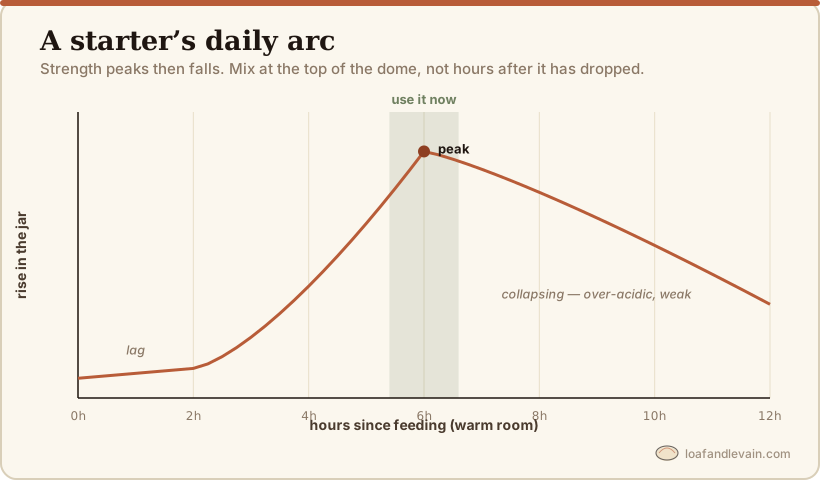
When Feed 2 has clearly doubled and is at peak, do one more feed at the ratio you'll bake with. For most home bakers that's 1:2:2 again. Take 20 g, add 40 g flour and 40 g water. Wait for peak.
A peaked starter looks like this: domed top, full of bubbles, smells like beer and yogurt. If you want a quick readiness check before mixing dough, the float test is the usual one — but it lies often enough that I treat it as a tiebreaker rather than gospel. See the float test guide for when to trust it and when to watch the jar instead.
Revival timeline by kitchen temperature
Temperature is the single biggest variable in how long each feed takes. The same starter that peaks in 5 hours in a 26°C (79°F) summer kitchen can take three times as long in a cold 16°C (61°F) room. Fermentation roughly halves for every 8°C you drop, the same Q10 relationship the bulk fermentation guide uses for dough — and it applies just as cleanly to starter feeds.
Use this as your planning grid. Times are hours to peak for a recovering starter; the first feed always runs longest because the population is at its weakest.
| Kitchen temp | Feed 1 (1:1:1) | Feed 2 (1:2:2) | Feed 3 (1:2:2) | Notes |
|---|---|---|---|---|
| 16°C (61°F) | 18–24 h | 12–16 h | 10–12 h | Cold and slow; expect a full 2 days. Find the warmest spot you have. |
| 20°C (68°F) | 12–16 h | 8–10 h | 7–8 h | Steady. The most forgiving temperature for a weak starter. |
| 22°C (72°F) | 8–12 h | 6–8 h | 5–6 h | The baseline most recipes assume. |
| 26°C (79°F) | 6–8 h | 4–6 h | 3–5 h | Fast — check early and don't let Feed 3 crash before you mix. |
A cold kitchen isn't a problem, just a slower schedule. The trap is a warm kitchen: at 26°C a recovering starter can peak and crash between feeds while you sleep, and you'll wake up to a sunken, watery surface that looks like failure but is really just bad timing. In summer, set an alarm or move the jar somewhere cooler. The summer sourdough guide covers managing a fast kitchen; the winter guide covers coaxing a slow one.
Use the calculator to plan backwards
The Starter tab in the calculator handles this math for you. Tell it when you need the starter ready, your kitchen temperature, and how many feeds you want (3 for a fridge-forgotten starter), and it gives you the exact times and amounts for each feed.
For example: if you want a peaked starter Saturday at 18:00 to mix dough, and your kitchen is 22°C (72°F), it might tell you Friday 17:00 wake-up feed (10/10/10), Saturday 04:00 build feed (10/20/20), Saturday 12:00 final feed (20/40/40), peaks 18:00. That's not something most bakers want to schedule in their head — let the tool do it, especially in a cold kitchen where the windows stretch long.
The maintenance schedule that prevents this
Once your starter is healthy again, you have two options to avoid forgetting it.
Option A: bake weekly. Feed Friday evening, mix dough Saturday afternoon, bake Sunday morning. Leftover starter goes back in the fridge for a week. This is the simplest schedule and keeps a starter happy with no extra effort.
Option B: bake monthly. Refresh the starter once a week — pull from fridge, do one feed at room temp until peaked, put it back. This adds 10 minutes a week and keeps the starter ready for an unplanned bake.
The trap is keeping a starter "for emergencies" without ever baking. Yeast needs to eat. A starter fed once every 6 weeks isn't being maintained — it's slowly dying. If you don't bake regularly, give a portion to a friend who does, dry a backup (a smear of starter dried on parchment keeps for months), and start fresh when you're ready to commit again.
For the ratio side of maintenance — when to use a tight 1:1:1 versus a loose 1:5:5 — see the feeding ratio guide.
Common questions
My starter smells like nail polish or acetone and won't rise. What's wrong?
It's starving, not dead. The starter has eaten all the available sugars and produced alcohol and acetone as a stress response. Pour off the hooch, discard most of the jar, and feed it generously — a 1:5:5 feed gives the surviving yeast lots of fresh food to work through. Repeat once or twice and the solvent smell gives way to a clean, fermented one.
I see bubbles but the starter never rises. How do I fix it?
The yeast is alive but the population is too low to lift the dough. Feed at a tight 1:1:1 for two cycles to concentrate what's there, then switch to 1:2:2 to build volume. Concentration first, expansion second — doing it the other way round just dilutes a weak culture.
My starter rises big, then collapses with a watery surface. Is it ruined?
No — it's over-fermented. It peaked and crashed before you caught it. The starter is fine; your timing is off. Keep the same ratio but catch it earlier next cycle, and check the temperature row above: a warmer kitchen than you assumed is the usual cause of a peak that arrives sooner than expected.
It peaked once, then didn't rise on the next feed. Why?
Usually the previous batch wasn't actually as mature as it looked, or the room temperature shifted between feeds. Don't panic and don't throw it out. Feed it at the same ratio, give it more time, and re-check. One inconsistent cycle during revival is normal; a recovering population isn't perfectly stable yet.
How do I know it's finally ready to bake with?
When it doubles reliably and predictably within the time the table above says for your kitchen, peaks with a domed, bubbly top, and smells like beer and yogurt rather than sharp vinegar. Two consecutive clean, on-schedule peaks is the real signal — more reliable than any single float test.
Can I speed up a slow revival in a cold kitchen?
Yes, gently. Move the jar to a warmer spot — on top of the fridge, near (not on) a radiator, or in an oven with just the light on, which usually holds around 26–28°C (79–82°F). Warmth shortens every feed in the table. Just don't go hot: above roughly 40°C (104°F) you start killing the yeast you're trying to save.
When revival isn't worth it
Give the protocol three honest cycles. If after three full rounds the starter still won't double within the time its temperature row predicts — and it's not just a timing miss you can see in the data above — stop nursing it. Whole-rye flour and water for 5–7 days builds a vigorous new starter from scratch, and rye gets going faster than wheat. The break-even is rarely more than a day of revival effort: past that, a fresh start costs you less time and a lot less doubt about whether the culture under your dough is actually strong. Start the new one the same afternoon you give up on the old, and you lose almost nothing.